What are the Differences Between Gravimetric and Volumetric Dosing Systems?
gravimetric and volumetric dosing systems ?
In industrial facilities, one of the most critical stages in establishing production standards, maintaining stable product quality, and controlling raw material costs is dosing . Mixing raw materials with gram tolerances, at the right time and in the correct proportions directly affects everything from the mechanical strength to the color homogeneity of the final product. Factories producing in sectors such as plastics, chemicals, food, or agriculture are forced to discard tons of raw materials or sell low-quality (second-grade) products if they cannot achieve the correct component ratios.
In this process, the two main technologies most frequently encountered by industrial maintenance, repair, and production professionals are gravimetric and volumetric. These are dosing systems. Both systems are designed to transfer material from one point to another, but their calculation algorithms and mechanical measurement capabilities are entirely different. In industry, we will examine the mechanical, electronic, and software differences between these two technologies in detail so that you can choose the system best suited for your facility.
Volumetric Dosing : Basic Principles and Mechanical Limitations

Volumetric Dosing is a hardware system where material is measured volumetrically, meaning that the amount of material that fits into a specific area (usually between the blades of a screw conveyor) is transferred over time. By maintaining a constant speed (RPM) of the screw conveyor, screw, or rotary valve via the drive frequency on the motor control panel, a constant volume of material is transferred to the system in a specific time.
The main reason for the system's widespread use in industry is its low cost of investment (CAPEX). It does not require complex PLC automation or precise weighing sensors . Thanks to its simple mechanical structure, mechanical maintenance and repair standards are low; technicians can quickly identify and repair faults. However, this hardware simplicity also brings some operational disadvantages.
Bulk Density Why is density a problem?
The biggest weakness of volumetric measurement is the difference in bulk density of the material . The volumetric system's inability to detect changes in mass ( density ) is a problem. Raw materials in powder or regrind form can become compressed while waiting in the silo, be affected by ambient humidity, or be aerated during transport. For example, a material that weighs 800 grams per liter in the morning at 50% humidity may drop to 750 grams per liter in the afternoon after drying or aeration. Since the motor of the volumetric system continues to rotate at the same speed, the actual mass (grammage) entering the recipe fluctuates, and the quality of the final product deteriorates.
Gravimetric Dosing : The Power of Mass Measurement and Automation

Gravimetric systems, on the other hand, measure material directly based on weight (mass) rather than volume. The entire machine or weighing pan is mounted on highly sensitive load cell sensors . Thanks to this system, the amount of material lost per second is calculated with millisecond scanning times. Even if the density, particle size, moisture content, or viscosity of the material changes instantaneously, the system automatically calibrates the motor speed in real-time to maintain the target weight.
Self-Calibrating PID Systems
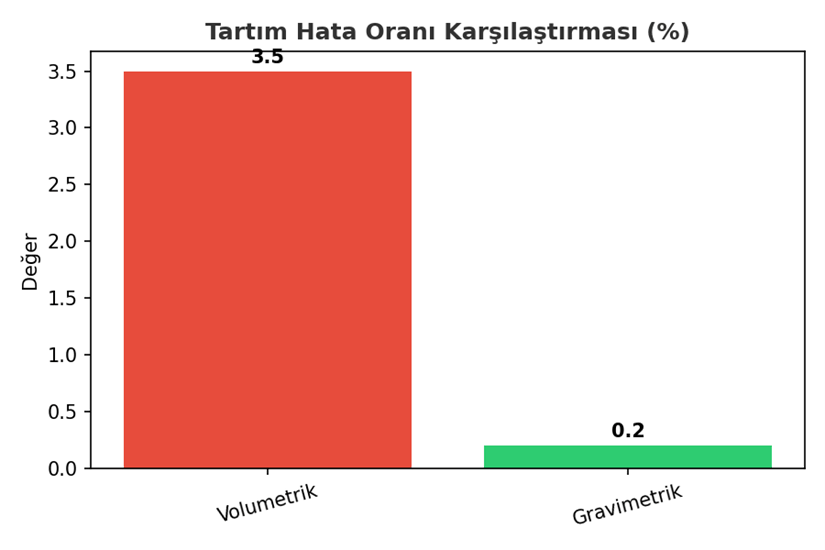
gravimetric technology are PLC algorithms that send continuous correction frequencies to motor drivers ( inverters ) via PID (Proportional-Integral-Derivative) control loops. If the powder material suddenly compresses and condenses, the load cell detects this within milliseconds, increasing the mass discharged from the screw conveyor, and the PLC automatically reduces the motor speed. This continuous feedback mechanism enables uninterrupted production with exceptional accuracy of 0.1% to 0.5% without the need for human intervention or sampling .
|
Technical & Operational Specifications |
Volumetric Dosing |
Gravimetric Dosing |
|
Measurement Principle |
Volumetric (Screw speed / time ratio) |
Mass (Weight loss / time) |
|
Weighing Accuracy |
Low - Medium (Extremely dependent on material density) |
Very High (Independent of density variations) |
|
Cost of Investment (CAPEX) |
More economical, low-budget. |
Higher Investment (But Very Fast ROI) |
|
Automation and Control Panels |
Basic motor control, simple contactor or drive. |
Advanced PLC, SIWAREX weighing module, PID loop. |
|
Calibration Needed |
Manual sampling and adjustment are required with each batch change. |
calibration ) and continuous via software. |
Which System Should You Choose? Decision Matrix
If the raw material used in your production line always flows at a consistent density (e.g., perfectly homogeneous plastic granules, wheat, or standard grains) and you have a wide tolerance range in your product recipe, volumetric systems will more than meet your needs in terms of price/performance. Especially in agricultural product conveying or mining, volumetric screw conveyors provide years of trouble-free service.
However, if the characteristics of your raw materials constantly change on a batch basis, if you use recycled regrind plastic, and if you are in an industry such as pharmaceuticals, colored masterbatch , or construction chemicals where even a 1% error can lead to product rejection, then gravimetric systems are absolutely essential. Gravimetric systems completely prevent the over-dosing of expensive raw materials, creating savings that will recoup the price difference within months.
|
Target Application Area |
Recommended System Type |
Engineering Reasons |
|
Plastic Extrusion ( Masterbatch ) |
Definitely Gravimetric |
To minimize color variations and prevent costly paint waste. |
|
Grain, Cereal and Feed Processing |
Volumetric / Gravimetric |
The relatively stable granular structure makes it suitable for volumetric measurements , but gravimetric measurements are preferred for warehouse monitoring . |
|
Construction Chemicals (Cement, Additives) |
Definitely Gravimetric |
Precise millimeter measurement of cement and freeze-retardant additives is essential for product strength. |
Frequently Asked Questions
Gravimetric How precise is the dosing device?
Gravimetric systems generally offer excellent weighing accuracy, ranging from 0.1% to 0.5%, depending on the load cell quality used, mechanical insulation, and environmental vibrations. This rate can be further improved in precise micro- dosing designs.
volumetric systems be subsequently converted to gravimetric structures?
If the existing machine's mechanical chassis, motor, and auger are sufficiently stable, the system can be revised by adding platform-type load cells , weight reader modules, and an advanced gravimetric control panel. However, this process requires high-level hardware expertise.
Which system is easier to maintain and repair mechanically?
Volumetric systems are easier to troubleshoot and maintain because their mechanical components and electrical panels are simpler. Gravimetric systems use sensitive electronic sensors , but PLC-based software diagnostic capabilities significantly speed up troubleshooting.
How to adjust the screw conveyor motor speed during dosing ?
high-resolution motor drivers (VFD/ inverter ) in the automation panel, the frequency (Hz) going to the motor is adjusted with millimeter precision, allowing the motor's speed (RPM) to be controlled without any loss of torque .
Bulk density What is density and why does it change?
Volume is the mass of a material per unit volume when it is in powder, granular, or liquid form. Increased humidity in the environment makes the powder heavier, while aeration during transport makes it lighter. These volumetric changes can immediately mislead volumetric weighing.
Gravimetric What is the average return on investment (ROI) of dosing ?
overdosing of expensive additives, it usually fully amortizes the entire investment cost within 6 to 12 months, depending on capacity.
To examine the practical applications and sectoral use areas of powder dosing systems in different industrial fields , please see our article "Sector-Specific Solutions in Dosing Selection". You can take a look.
customized powder dosing systems for your factory and all the necessary technical information, please review our Dosing Systems product.