Correct Screw Selection and Torque Calculation in Dosing Augers
How to Choose the Right Screw for the Desired Capacity When Selecting a Dosing Screw?
The beating heart of dosing machines and transfer stations is the screw (industrial screw conveyor) that physically transfers tons of raw material from the silo to the bunker or weighbridge, bringing the system to life. No matter how superior your Siemens PLC automation or the world's most precise loadcell system, if the geometry of the screw providing the physical transfer is not compatible with the physical chemistry of the material, that plant can never operate at its design capacity and without problems.
Incorrect screw or pitch selection can cause hard materials like plastic granules to be crushed and broken down by being jammed between the screw tubes, sensitive products like coffee or flour to overheat (roast) due to high friction, the desired tonnage capacity to never be reached, or the 3-phase motor drives (inverters) in the electrical panel to burn out due to exceeding their current limits because of excessive torque (resistance) caused by jamming. From massive state-owned grain storage facilities like TMO to sensitive biochemical factories producing micronized products, a screw selection that fully complies with mechanical maintenance and repair standards and is based on correct mathematical calculations is essential in every field.
Screw Pitch, Diameter Relationship and Capacity Engineering

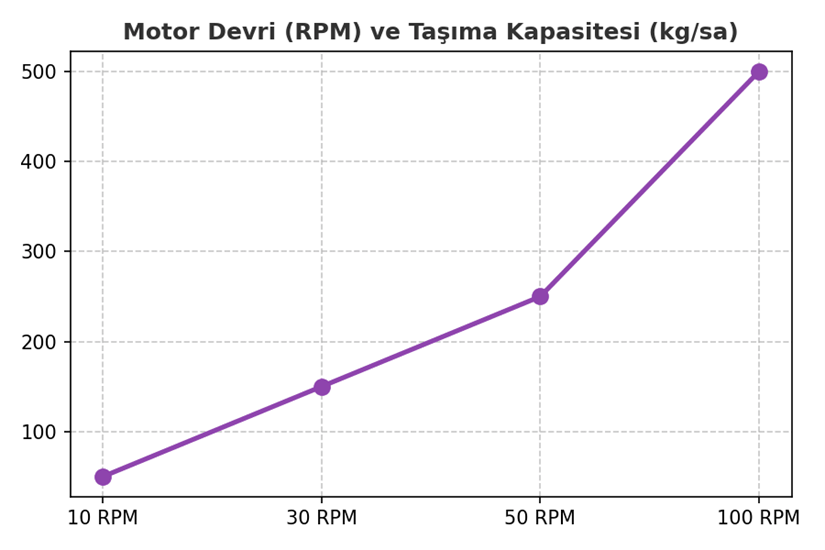
There are three inseparable fundamental engineering elements that determine the theoretical conveying capacity and mechanical efficiency of a steel screw conveyor: the screw's outer shaft diameter (how wide it is), the screw pitch (the distance between two adjacent steel sheets), and the rotational speed (RPM) of the drive motor to which it is connected. While the screw diameter and pitch are proportionally increased for applications requiring high conveying tonnage and capacity, micro-screws with a very small diameter, tight pitch, and a motor rotating at a very low speed are preferred for micro-dosing applications where milligram-level color or additive accuracy is required.
The Dangers of Speeding
A common industrial installation mistake is to dangerously over-increase the motor's speed (RPM) via an inverter in the hope of obtaining high capacity from a small-diameter, narrow-pitch screw. This creates excessive friction along with centrifugal force, rapidly wearing out the motor's bearings and, if the material is food-grade or plastic, causing it to heat up, melt, and burn inside the screw conveyor, ultimately seizing and clogging the entire system.
|
Industrial Screw (Auger) Type |
Mechanical Design Feature |
Primary Uses and Raw Materials in Industry |
|
Standard Solid/Shafted Screw Conveyors |
The metal spiral blades are fully and completely welded from end to end to a thick, solid central steel shaft. |
Free-flowing, non-sticky, dry granular and grain-form products (e.g., granular plastic, grain, sand, dried beans) |
|
Spring / Spiral (Flexible / Shaftless) Centerless Spiral |
It lacks a central metal shaft; it is manufactured in the form of a thick spring, making flexible rotation by contacting the outer tube. |
Fibrous waste that poses a risk of entanglement in the screw shaft, very moist, excessively sticky paste-like dusts, and curved conveyor lines. |
|
Twin-Screw (Intermeshing) |
Two parallel screw systems rotating in opposite or the same direction, completely interlocking like gears. |
Products in powder form that have near-zero fluidity, solidify into a concrete-like consistency when compressed, and are extremely stubborn and difficult to clean up, causing bridging and blockage (e.g., titanium dioxide). |
Calculation of Torque and Mechanical Power for 3-Phase Asynchronous Motors (KW Requirement)

As the bulk density and friction coefficient of the material increase (for example, when conveying cement or heavy iron powder instead of airborne dust), the torque of the 3-phase asynchronous motor required to rotate the screw inside the pipe increases exponentially. In such demanding situations, the mechanical ratios of the gearbox transmitting power from the motor to the screw must be carefully calculated to maximize torque, and subsequently, in the industrial MCC (Motor Control) panel design, the current limits of the motor drivers (inverters) and the thermal relay values must be correctly adjusted to protect the motor.
Otherwise, the strong impact and strain wave created by a dense material on the screw could burn out the motor, and the resulting shock wave could hit the chassis, directly causing the sensitive loadcell sensors on the scale to bend physically and resulting in permanent failure.
Tubular or U-Type Boat Bedding Design Choice
The external housing system in which the rotating screw is enclosed and operates, and which transports the material, can be a closed steel tubular type or a horizontal trough in the form of a U-shaped trough with a top cover. In constantly changing plastic paint lines or food processing plants with allergen sensitivities, cleaning tubular screw conveyors is very difficult, so wide, open U-shaped designs with top-locking hinged covers that allow easy access and cleaning with compressed air and water are much more practical.
|
Flow Characteristics of Raw Material |
Recommended Screw Design and Hardware Type |
Recommended Screw Maximum Rotation Speed (RPM Capacity) |
|
Very Good (e.g., Plastic Granules, Dry Wheat, Silica Sand) |
Center-mounted, standard solid (shafted) spiral. |
High transmission speed is extremely convenient and safe (Max. 150 RPM) |
|
Very weak and stubborn (e.g., powdered sugar, slaked lime, flour) |
Centerless Steel Spring Helical or Twin-Screw |
To prevent engine stalling and dust clogging, low torque speed is required (Max. 30-50 RPM). |
|
Liquid / Semi-Liquid Viscous Pastes |
Metal Gear Pump or Customized Helical Blade Structure |
Specific speed control via PLC based solely on instantaneous viscosity tests of the material. |
Frequently Asked Questions
In engineering, how is the capacity (kg/hour) of a dosing screw calculated using a formula?
The screw capacity is theoretically calculated precisely using the formula: Screw Capacity = (Effective Surface Area of the Screw) × (Screw Pitch) × (Motor Revolutions per Minute - RPM) × (Material Mass Density), with the factor representing the percentage of material that can fill the screw (Filling Factor) also included in the tolerance calculation.
In which specific technical scenarios is a shaftless/spring-type screw necessary?
often without a central support shaft, are used in wastewater treatment plants to physically prevent very sticky materials, such as wet sludge, or long fibrous materials, such as textile waste, from wrapping around a medium-thick shaft and completely clogging the pipe over time.
What should be the millimeter-sized clearance (tolerance) between the outer casing (steel pipe) of the helical screw and the rotating screw leaf?
If the material to be conveyed is a large granule or grain, the gap must be either much narrower than the largest granule diameter (to prevent it from entering) or much wider (to allow it to rotate freely without jamming). Otherwise, the material will get stuck and crushed, locking the motor. If it is a fine, volatile powder, this gap must be minimized to a few millimeters to prevent friction and ensure the material does not spill back.
Does running the motor at high RPM for rapid capacity increase always damage the material's structure?
Yes, it is a significant risk. Especially in the food industry with delicate roasted coffee beans or in the chemical industry with microencapsulated special plastic granules, unnecessarily high RPMs can create a serious centrifugal force, causing the material to collide with a wall and crack (crumble) or, due to increased mechanical friction, overheat and melt, leading to the material sticking.
How to remove and clean old or painted material left inside a long pipe during cleaning?
In modern, state-of-the-art dosing equipment (e.g., Easy-Clean configurations), the rear motor and gearbox block are pulled backward on special sliding rails, allowing the long screw to be completely removed from the housing in seconds. This illuminates the inside of the housing, making it easy to clean thoroughly with compressed air or high-pressure water (CIP).
Is it absolutely essential, or should expensive, stainless steel screw conveyors be preferred in dosing machines?
If the production line handles food products that pose a risk to human health, pharmaceuticals, or aggressive chemical acids that carry a corrosion risk, then absolutely yes. However, for heavy industrial applications such as coal, lignite dust, or construction cement, using hardened standard ST37 or ST52 carbon steel is much more robust and economical, resisting bending and fracture.
To quickly resolve load cell problems that may occur in screw conveyors and weighing mechanisms, you can refer to our troubleshooting guide, "Loadcell Failures and Solutions in Dosing" .
For customized powder dosing systems for your factory and all the necessary technical information, please review our Dosing Systems product.