Solutions for Bridging and Rat-holing Problems in Powders
How to solve the problem of powder bridging and clogging during the dosing process?
In all industrial plants where raw materials in powder form (flour, calcite, cement, cocoa, spices, etc.) are processed, one of the biggest nightmares for process engineers and maintenance technicians is material clogging in bunkers or silos. These stubborn blockages, known as 'bridging' or 'rat-holing', suddenly stop the flow of raw materials, halting the entire production line, leading to gravimetric weighing errors, and the production of faulty recipes costing tens of thousands of liras.
To permanently overcome this problem, instead of temporary solutions such as operators hitting the silos from the outside with hammers, bunkers designed with the correct geometry, conforming to mechanical maintenance and repair standards, powerful agitator (mixer) motors, and directed pneumatic vibration systems should be selected. Furthermore, the screw conveyor pitch must be correctly configured to avoid straining the material during discharge.
Why Exactly Do Bridging and Mousehole Formations Occur?

Bridging is the process where dust particles mechanically interlock due to surface tension, airborne moisture, static electricity, or simply their own weight, forming a concrete 'arch' or 'bridge' over the bunker's exit hole. No matter how much the screw conveyor below rotates, the material cannot fall down due to this arch. Rat-holing, on the other hand, occurs when material flows down only through a thin tunnel in the center, while the material on the side walls of the bunker remains attached to the wall (creating dead volume), reducing the storage capacity by half.
Raw Material Physics and Friction Coefficient
Materials such as cement, powdered sugar, calcium carbonate (calcite), cellulose, and titanium dioxide have very small particle sizes, resulting in very high intergranular cohesive forces. If the hopper angle of the silo is not compatible with the material's natural angle of repose, the material can never free-flow. Achieving precise formulas in such stubborn materials presents a significant mechanical challenge.
|
Obstruction Formation |
Cause of Formation |
Impact on the Production Line |
|
Arching |
Particles interlocking to form an arch at the exit. |
Complete cessation of flow, gravimetric system alarm, and formula error. |
|
Rat-holing |
The highly cohesive powder flows only from the center. |
Inefficient use of bunker capacity, spoilage of old material left at the edges. |
|
Segregation |
Separating light and heavy particles by vibration. |
Disruption of mixture homogeneity, variation in product quality on a lot basis. |
Definitive Solution Methods: Mechanical Mixers (Agitators)

Horizontal/vertical mechanical mixers (agitator blades), positioned independently or synchronously with the central shaft inside the bunker, ensure the material remains in constant motion and prevents clumping. Driven by a powerful, high-torque 3-phase asynchronous motor or gearbox, these mixers continuously scrape the side walls of the bunker, physically cutting away the bridge of compacted material.
The Importance of Isolation in Gravimetric Weighing
If your dosing device uses gravimetric weighing, the strong rotational vibration applied by the agitator motor to the chassis can mislead the load cell sensors. Therefore, it is essential that the mixing motor assembly is perfectly balanced, that the connection points are isolated from the chassis with flexible damping pads, and that the analog filtering settings in the PLC software are flawlessly configured.
Pneumatic (Air Shock) and Vibratory (Vibration) Solutions
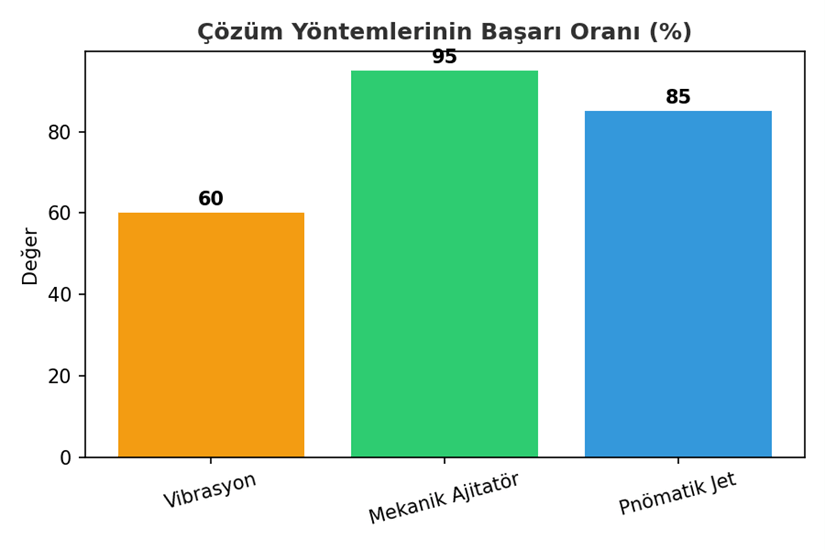
External intervention systems are activated when mechanical blades can physically damage the raw material (e.g., delicate coffee beans or coated granules) or when they don't fit within the system. Pneumatic air knockers integrated into the bunker body send periodic air shocks, instantly dislodging the compacted dust. However, vibration motors are not a magic wand for all dust; if the dust is very fine and moist, continuous vibration can turn it into concrete, causing it to compact further and leading to permanent blockage.
|
Mechanical/Pneumatic Solution Method |
In what situations and where is it used? |
Operational Advantage |
|
Mechanical Agitator (Blade Mixer) |
In sticky, moist, and very difficult-to-flow light/heavy powders |
It keeps the material consistently homogeneous, guaranteeing 100% flow. |
|
External Vibration Motor |
Only in dry, lightweight, and non-compacting powders |
It is economical, has low energy consumption, and can easily be welded to an existing bunker. |
|
Pneumatic Air Jets (Air Pad / Knocker) |
In compacted, petrified heavy dust and cement silos |
It instantly detonates and breaks the bridge by sending a shock wave or airbag inside. |
Frequently Asked Questions
Does change in the moisture content of the dust directly affect bridging?
Absolutely yes. High humidity in the factory air or within the material itself causes dust particles to stick together (forming capillary water bonds), instantly triggering bridging.
Would using a flexible (spring) coil alone solve the bridging problem?
No. Flexible screw conveyors only facilitate horizontal and angled conveying within the pipe. Mixers that intervene inside the material are absolutely necessary to resolve bridging at the main throat of the bunker.
Why does a vibration motor sometimes make things worse instead of helping?
If the powder material is micron-fine and contains moisture, vibration will only push the air inside the material upwards, compressing the powder downwards like concrete, leading to a more lethal blockage.
Could the angled conical design of the dosing bunker prevent clogging from the outset?
Partially yes. Designing the bunker walls asymmetrically (one side vertical, the other side angled) and ensuring the conical angle is perpendicular to the material's coefficient of friction reduces the risk of clogging by 70% from an engineering perspective.
What is the proper mechanical maintenance for continuously running agitator motors?
Motor currents (Amperes) should be continuously logged and monitored via the industrial PLC control panel. If the no-load current increases, it indicates wear on the motor bearings or gearbox gears, and periodic maintenance should be performed immediately.
How can capacity loss due to clogging in powder dosing be detected immediately?
Thanks to advanced PLC PID automation, the difference between the target weight (set point) and the actual flowing weight is calculated within seconds, and if they don't match, the system immediately sends an HMI alarm to the operator saying 'material not flowing / bridging occurred'.
To learn about one of the most preferred dynamic weighing methods in precise dosing, you can find the technical details in our guide , "What is the Loss-in-Weight Principle in Dosing?" .
For customized powder dosing systems for your factory and all the necessary technical information, please review our Dosing Systems product.