What is the Loss-in-Weight Principle?
How does the loss-in-weight principle work in dosing applications?
Loss-in-weight feeding is a leading gravimetric dosing method that enables the accurate feeding of powder, granular, pellet, or fibrous materials into process lines. In continuous production facilities such as plastic extrusion, food production, chemical processing, and pharmaceutical manufacturing, maintaining a consistent material dosage in grams directly impacts product quality. This article details the working principle of loss-in-weight feeders, load cell technology, control algorithms, and the technical criteria to consider for accurate feeder selection.
What is a Loss-in-Weight System?
Losses weighing is a dosing method that continuously measures the weight loss of material in a hopper over time and converts this weight loss data into the actual feed rate (kg/hour). Unlike volumetric feeders, the system is not affected by changes in material density because the measurement is done directly from the mass. This approach is critical, especially for materials requiring precise dosing, such as powders, recycled granules, glass fiber reinforced components, and masterbatch, where density can vary from batch to batch.
A lossy weighing feeder consists of three main components: a material hopper, a load cell assembly that supports the hopper, and a control unit that drives the feeding unit (screw feeder, vibrating chute, or rotary table). When the hopper is full, the total weight is recorded; when feeding begins, the rate of weight reduction is continuously monitored, and this rate is compared to the target set flow rate, thereby instantly correcting the feed motor speed.
Working Principle: Weight Loss-Based Measurement Logic
The heart of the system is the continuous matching of weight measurement and feed rate within a closed-loop control loop. The controller reads the hopper weight at a specific sampling interval (usually well under a second), calculates the difference from the previous reading, and derives the instantaneous mass flow rate by dividing this difference by the time unit. The resulting value is compared to the set-point flow rate entered by the operator, and the feed motor speed is corrected using a PID control algorithm.
Load Cell Technology and Precision
Load cells are strain-gauge based sensors that convert microscopic changes in hopper weight into electrical signals. In industrial lossy weighing applications, cells with a resolution between 0.1 grams and 1 gram are generally preferred. Since vibration, electromagnetic interference, and temperature fluctuations directly affect measurement accuracy, the cells must be mounted on insulated mounting plates and supported by digital filtering algorithms.
Control Algorithm and Feedback Loop
Modern lossy weighing controllers use self-tuning algorithms that automatically adapt PID parameters to material properties. Since there is a temporary interruption in measurement during hopper refilling, the system switches to volumetric backup mode during this time to maintain supply continuity and automatically returns to lossy weighing mode once refilling is complete.
Differences Between Lossy Weighing and Volumetric Dosing
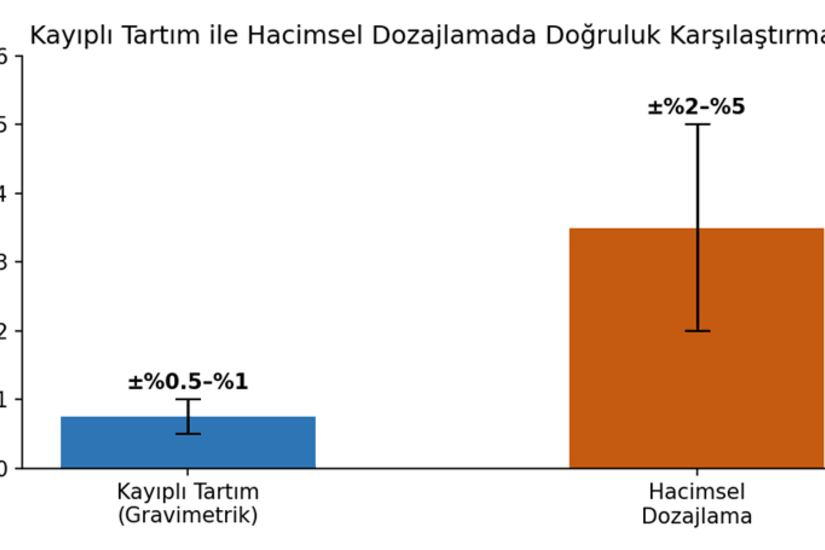
Understanding the fundamental differences between the two methods is essential for selecting the correct feeder. In applications where material density does not remain constant throughout the process, volumetric systems can lead to significant dosage deviations; this is where the gravimetric principle comes into play.
|
Criterion |
Lossy Weighing (Gravimetric) |
Volumetric Dosing |
|---|---|---|
|
Unit of measurement |
Mass (kg, g) |
Volume (liters, dm³) |
|
Affected by density changes |
Unaffected |
It is directly affected. |
|
Typical accuracy |
Between ±0.5% and ±1% |
Between ±2% and ±5% |
|
Investment cost |
Higher |
Lower |
|
Typical area of use |
Pharmaceuticals, food additives, masterbatch |
Construction material, premix |

Industrial Applications
Losses-free weighing feeders are widely used in almost every sector where weight accuracy directly affects product cost or safety. They are preferred in plastic extrusion lines for color pigment (masterbatch) and additive dosing, in the food industry for precise feeding of vitamins and flavor additives, in the chemical industry for reactor feed processes, and in cement/concrete plants for additive dosing.
|
Sector |
Application Example |
Typical Flow Rate Range |
|---|---|---|
|
Plastic / Extrusion |
Masterbatch and additive dosage |
0.5 – 500 kg/hour |
|
Food |
Flavor, vitamin, and mineral additives. |
0.1 – 200 kg/hour |
|
Chemical |
Reactor feed, powder mix |
5 – 2000 kg/hour |
|
Construction / Cement |
Additive, pigment dosage |
10 – 5000 kg/hour |
|
Medicine |
Active ingredient, excipient dosage |
0.05 – 50 kg/hour |

Technical Criteria to Consider When Selecting a Feeder for Loss Weighing
Capacity and Flow Rate Range (kg/hour)
The first criterion in feeder selection is that the targeted minimum and maximum flow rate ranges are compatible with the feeder's operating band. Operating an excessively large capacity feeder at low flow rates reduces accuracy; therefore, it is recommended that the flow rate range remains between approximately 10% and 100% of the feeder's nominal capacity.
Material Properties: Powder, Granule, Fibrous Structures
The flow characteristics of the material (free-flowing, sticky, prone to bridging) determine the type of feeding unit. Horizontal twin-screw feeders are preferred for fine powders, single-screw systems for free-flowing granules, and agitator-equipped hopper designs for fibrous or bridging-prone materials.
Hopper Volume and Refill Strategy
The tank volume determines the refill frequency and, consequently, the continuity of the process. Although larger tanks require less frequent refilling, weight discrepancies may occur in designs that do not operate in sync with the tank filling system (vacuum transfer, big-bag emptying unit, etc.). Therefore, it is recommended that a volumetric backup function, which activates during refilling, be included in the controller software.
|
Technical Parameters |
Suggested Value/Range |
|---|---|
|
Measurement resolution |
0.1 – 1 g |
|
Dosage accuracy (short term) |
±0.5% – ±1% |
|
Reservoir volume |
10 – 500 liters (depending on the application) |
|
Type of power supply unit |
Single screw / double screw / vibrating chute |
|
Communication protocol |
Modbus TCP, Profibus, Profinet |
Advantages and Limitations
The biggest advantage of lossy weighing systems is that mass accuracy is maintained even if material density or flow characteristics change. In addition, its ability to provide continuous production data recording (batch reporting, traceability) is a significant advantage for quality management systems. Limitations include higher initial investment costs compared to volumetric systems, the need for periodic load cell calibration, and the need for additional insulation in vibrating environments.
Frequently Asked Questions
What is the main difference between loss-in-weight systems and volumetric dosing?
While lossy weighing measures based on mass, volumetric dosing measures based on volume; therefore, dosage deviations can occur in volumetric systems when material density changes, whereas the weight remains constant in lossy weighing systems.
How accurate is the dosage of feeders with lossy weighing?
Depending on the application and material type, typical dosage accuracy ranges from ±0.5% to ±1%; this rate may be even lower in sensitive pharmaceutical and food additive applications.
How is dosage consistency ensured during reservoir refilling?
During refilling, the controller temporarily switches to volumetric backup mode and maintains the supply based on the last measured flow rate; the system automatically switches back to gravimetric mode when the reservoir stabilizes again.
What factors determine the price of a loss-weighted feeder?
The price is determined by factors such as capacity range, load cell sensitivity, hopper material (stainless steel, etc.), feed unit type (single/twin screw), controller software, and communication protocol options.
For which materials should a loss-based weighing feeder be preferred?
Powders, masterbatches, glass fiber reinforced granules, active pharmaceutical ingredients, and flavor/vitamin additives, whose density can vary from batch to batch, are preferred for materials where gram precision is critical.
How often should the load cells of a lossy weighing feeder be calibrated?
Manufacturers generally recommend periodic calibration every 6 to 12 months; however, this period can be reduced to 3 months for vibrating or high-tonnage lines.
Is a lossy weighing system suitable for small-scale production lines?
Yes; nowadays, loss-based weighing feeders operating at very low flow rates, such as 0.05 kg/hour, are also produced for laboratory and pilot plant applications, allowing small-scale lines to benefit from gravimetric accuracy.
To maximize measurement accuracy in loss-in-weight and other weighing systems, you can read our guide on "How to Increase Weighing Accuracy in Dosing?" .
For customized powder dosing systems for your factory and all the necessary technical information, please review our Dosing Systems product.