Flawless Recipe Control and PLC Automation in Construction Chemicals
Flawless Recipe Control in Construction Chemicals Thanks to Dosing Automation
The unsung heroes behind the global construction and modern architecture market are building chemicals. In the production of critically important products such as cement-based ceramic adhesives, high-strength grout, thermal insulation plasters, self-leveling floor screeds, and repair mortars, hundreds of tons of heavy silica sand, binder base cement, dense filler calcite, lightweight cellulose fibers, and very expensive polymer powders are mixed in a complex alchemy.
Even millimeter-scale weighing errors in the mixing ratio (production recipe) of these materials in the mixer can completely destroy the adhesion strength, freeze/thaw resistance, and ultimate flexibility of the construction material to the wall. Scenarios where thousands of square meters of tiles fall off the wall due to a shortage of just a few grams of chemical additives are frequently seen in the industry. Achieving a reliable quality standard, completely independent of human error, operator fatigue, and initiative, is only possible with advanced SCADA software, PHP/MySQL-based recipe databases running in the background, and high-level PLC automation.
Centralized SCADA System for Formula and Production Management

In older, traditional facilities, operators would pull raw materials from silos, manually stopping the conveyor belt using buttons based on their own instincts and the digital display (indicator) of the scale (leading to incredible errors). In modern technological systems, everything is managed centrally. Using a SCADA interface in a central computer system or the factory's backend ERP databases, hundreds of complex recipes developed by the R&D department in the laboratory are securely defined in the system's memory (SQL database).
Flawless Blending with a Single Button
All the field operator needs to do is select the product to be produced at that moment (e.g., Facade Insulation Mortar) from the touchscreen (HMI) and simply touch the 'Start Automatic Production' virtual button. From that moment on, the PLC in the system automatically pours and mixes the sand silo, cement screw conveyor, and additive micro-dosers sequentially (or simultaneously), calculating the tare weight of the free-falling material dynamically using PID formulas, with zero error.
|
System Control Hierarchy |
Working Methods and Processes in the Factory |
Risk of Error and Quality Impact |
|
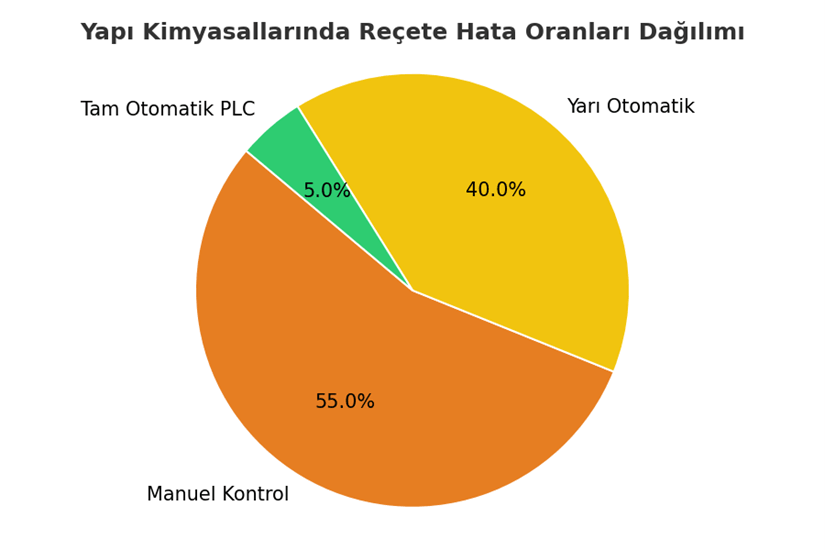
Traditional Manual Control |
The operator, looking at the scale screen, presses the motor button relying on their own eye and hand reflexes to stop the system. |
Very High (100% susceptible to negligence, staff fatigue, and night shift errors) |
|
Partially Semi-Automatic |
The simple cutoff relay inside the indicator roughly disconnects the motor contactor when it approaches a certain weight (set value). |
Medium risk (Algorithmic compensation for drop/flight trajectory of airborne material is not possible) |
|
Fully Automatic (PLC+SCADA Supported) |
The advanced PLC algorithm pre-calculates the target weight, the material's flight speed, and its density, and then slows and locks the motor at precise times using a VFD drive. |
Negligible, laboratory accuracy (Tolerance ±0.5% and below) |
Mechanical Control of Abrasive (Sanding Effect) and Dense Materials

The construction chemicals sector undoubtedly presents one of the most demanding and challenging environments for dosing machines and mechanical installations. Silica sand and crushed stone dust inside act like sandpaper, eroding and melting standard metal and steel surfaces within weeks; while very light powders such as cellulose, powder coatings, or polymeric additives tend to fly around with the slightest airflow and stick to the bunker ceiling.
Due to these extreme challenges, the screw blades and transmission pipes must be manufactured with tungsten carbide hardfacing, one of the world's most wear-resistant alloys, or armored with Hardox/Raex steel plates. Similarly, to ensure the pouring of materials in the form of cement that stick and resist flowing, and that compact and solidify, onto the scales and bunkers, powerful pneumatic air knocker systems and intelligent agitator blades must be integrated into the scales and bunkers.
Traceability and Big Data Reporting
The most strategic and managerial advantage that a PLC automation system brings to your factory is the concept of 'Traceability'. The system stores data (Big Data) in databases such as SQL, detailing exactly when, at what hour, and in what second each production batch in a shift had the exact amount of material missing or in excess, as well as the amperage loads drawn by the screw conveyors.
Providing Evidence in Consumer Complaints
When a customer files a complaint or requests for legal action weeks later stating, "Your plaster didn't adhere to the wall; it's crumbling," the production (lot) barcode number on the packaging is retrospectively examined through the SCADA system. This provides irrefutable digital evidence (log file) demonstrating whether the cellulose additive and cement were included in the mortar recipe precisely and completely at that specific time and date . This protects your factory from significant legal and commercial damages.
|
Standard Prescription Materials |
Physical and Mechanical Difficulties Created in Production |
Engineering and Automation Strategy |
|
Washed Silica Sand (Main Body Filling) |
Highly abrasive, very high mass and heavy tonnage castings. |
Wear plate thick-leaf apparatus, low-speed volumetric power feeding system. |
|
Portland Cement (Main Binding Strength) |
It compresses under its own weight in the bunker and silo, forming an arch/bridge. |
Powerful vibrator-assisted, closed-loop pneumatic screw conveyor with load cell tracking. |
|
Cellulose / Polymer Additives (Strength Enhancers) |
In powder form, it is very light, very expensive, aerates, and adheres to walls. |
High-precision, small-diameter micro-gravimetric loss-in-weight helical unit isolated from the outside world. |
Frequently Asked Questions
Can an advanced centralized SCADA and PLC system be retrofitted (through revision) to an existing manually controlled facility?
Yes, it is absolutely possible. If the existing screw conveyors, gates, and weighing unit on site are mechanically sound, the old analog motor panels can be removed and replaced with a new smart panel containing a PLC and motor driver (VFD). By installing pneumatic pistons and new load cell sensors in the weighing gates, the entire plant can be fully automated and modernized within weeks.
Why is the dosage precision of microadditives so extremely important in prescriptions?
Micro-additives, which constitute only about 1-2% of the chemical formula (for example, special celluloses and polymers that delay setting time), account for almost 50% of the material cost of the manufactured construction chemical. Insufficient inclusion in the recipe leads to the product not adhering to the wall (quality rejection), while excessive addition during production completely eliminates the factory's profit margin (hidden bankruptcy).
How can rapid wear and tear on metal screw tubes and blades during the dosing of tons of sand be permanently prevented?
There is no material that can completely overcome mechanical friction, but you can dramatically extend its lifespan. By thickening the coil spring plate instead of standard steel, and by applying 'Tungsten Carbide' weld filler to the outer edges of the blades where sand friction is most intense, and installing replaceable bolted Hardox armor plates inside the housing, the coil spring's lifespan can be increased by 4-5 times.
Can the production and consumption reports generated by the facility be instantly transferred to the factory's accounting/ERP programs?
Yes, advanced industrial PLC systems and SCADA computers, such as the modern Siemens S7 series, can send real-time (in real seconds) raw material consumption and production batch data to SAP, Logo, Mikro, or custom-designed on-premise ERP programs via the OPC-UA protocol or SQL database queries. This automates inventory reductions.
If a major power outage occurs at the factory in the middle of production, will the recipe being prepared at that moment be erased from memory or canceled?
No, it definitely won't go to waste. Thanks to the 'retentive memory' (or M-RAM) module on high-quality PLC hardware used in industrial automation, the system doesn't forget how many kilograms of which product it weighed at the exact second the power is cut off; it freezes the data. When the generator or mains power returns, the system safely resumes production from where it left off, precisely at the weight it stopped at.
For small, boutique production batches of 10-20 kg in construction chemicals, should a weighing belt or a weighing bunker/screw conveyor be preferred?
In construction chemicals, to prevent materials from being blown away and becoming dusty (and polluting the environment) and to protect materials of very different densities (sand vs. cellulose) from the wind, closed-system loadcell weighing bunkers (hopper scales) and sealed screw conveyors should always be the first engineering choice instead of open and long weighing belts.
To learn about the most basic mechanical conveying elements that ensure recipe control and product transfer, you can review our technical article on " How to Select Screws for Dosing Screw Conveyors?" .
For customized powder dosing systems for your factory and all the necessary technical information, please review our Dosing Systems product.