Flexible Screw Conveyor Tube Selection and Wear Resistance | OMMIX
Tube Selection in Flexible Screw Conveyors: The Relationship Between Diameter, Material, and Capacity
In flexible screw conveyor systems, another component as important as the spiral spring is the pipe or hose in which the spring rotates. The pipe both isolates the conveyed material from the external environment, ensuring dust-free transfer, and acts as a guide for the smooth and balanced rotation of the spring. Pipe selection in flexible screw conveyors depends on several parameters, including pipe diameter, wall thickness, material type (carbon steel, stainless steel, or PVC), and degree of flexibility.
This article examines in detail how to select the correct tube in flexible and rodless screw conveyor systems, the effect of tube diameter on load-carrying capacity, and the recommended tube types for different sectors. Tube selection should be considered together with the spring to be used; for spring-tube compatibility, you can also refer to our article titled " Spring Selection in Flexible Screw Conveyors ".
The Role of Pipes and Hoses in Flexible Screw Conveyors
Flexible screw conveyors (or hoses) create a closed conveying line by winding a rotating spiral spring inside. Thanks to this closed structure, the transported powder or granular material is not dispersed into the external environment and is protected from moisture and contamination. Furthermore, the pipe counteracts the radial forces generated by the spring during conveying, ensuring the stable operation of the system. Two main pipe types are used: fully flexible PVC/rubber hoses (for lines requiring high flexibility in complex routes) and semi-flexible metal pipes (for longer lines with fewer changes in direction). In addition, U-type (open) and fully closed pipe screw conveyors are also widely used in the industry; the closed pipe type is preferred for dusty and hygienic materials.
Relationship between Pipe Diameter and Load Capacity
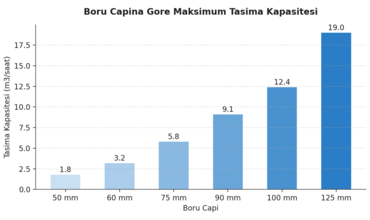
As the pipe diameter increases, the volume of material the spring can carry also increases. However, an increased pipe diameter also requires a more powerful motor and a thicker spring. The graph below shows the approximate maximum conveying capacities for different pipe diameters:

For example, a 50 mm diameter pipe is generally preferred in low-capacity dosing applications, while diameters of 100 mm and above are used for high-volume grain, feed, or granule transfer. When selecting pipe diameter, not only the immediate capacity but also the future growth needs of the operation should be considered. You can find information on how to evaluate motor speed and pipe diameter together in our article on motor speed selection in flexible screw conveyors .
Pipe Material Selection: Carbon Steel, Stainless Steel, or PVC?
The choice of pipe material is determined by the sector of the product being transported and the hygiene requirements. In the food, pharmaceutical, and cosmetics industries, stainless steel pipes are preferred because they are easy to clean, corrosion-resistant, and can be manufactured to meet food safety standards (FDA, CE). In agriculture and general industrial applications, carbon steel pipes are widely used due to their low cost and high strength. If flexibility is a priority in complex routes, PVC or reinforced rubber hoses are preferred.
|
Pipe Material |
Featured Feature |
Typical Use Sector |
|---|---|---|
|
Stainless steel (304/316) |
Hygienic, corrosion-resistant, easy to clean. |
Food, pharmaceuticals, chemicals, cosmetics |
|
Carbon steel |
High durability, economical cost. |
Agriculture, feed, construction, mining |
|
PVC / reinforced hose |
High flexibility, lightweight, easy to maneuver. |
Narrow spaces and complex routes |
|
Wear-resistant steel (Hardox type) |
High wear resistance |
Transporting mining dust, sand, and aggregates. |
Pipe Wall Thickness and Flexibility Level
Pipe wall thickness determines the system's resistance to pressure and mechanical shocks. Pipes with thinner wall thickness are preferred in confined spaces and lines with numerous changes in direction because they are more flexible; however, their lifespan against wear is shorter. Pipes with thicker wall thickness have a longer lifespan but their flexibility is reduced, and their bending radii must be wider. The general rule preferred in practice is that the pipe bending radius should be at least 8-10 times the pipe diameter; this ensures smooth rotation of the spring and uninterrupted material flow.
Other Factors to Consider When Selecting Pipes
• Abrasiveness level of the material being transported: Thicker wall thickness should be preferred for abrasive products.
• Ambient temperature: In high-temperature environments, metal pipes provide more reliable results than PVC.
• Hygiene requirements: Stainless steel and easily removable connections should be preferred in food and pharmaceutical applications.
• Pipeline route: Flexible hose-type pipes offer an advantage in lines with numerous bends and changes in direction.
• Pressure resistance: In high-capacity and long lines, the pipe wall thickness should be calculated according to the pressure of the material being transported.
Why is pipe selection different for long-distance pipelines?
For lines longer than 20 meters, pipe wall thickness and support points should be planned differently compared to shorter lines. You can find detailed recommendations on this subject in our article titled "Use of Flexible Screw Conveyors in Long Lines" .
Frequently Asked Questions About Choosing Flexible Helical Tubes
What material is flexible spiral tubing made of?
Flexible spiral tubes can be manufactured from carbon steel, stainless steel (304/316), or PVC/reinforced rubber hose. The choice depends on the type of material being conveyed, hygiene requirements, and the complexity of the pipeline route.
How is the diameter of a flexible spiral tube determined?
Pipe diameter is determined according to the targeted conveying capacity (m³/hour or tons/hour), the specific gravity of the material being conveyed, and the available engine power. The most common diameters on the market are 50, 60, 75, 100, and 125 mm.
What is the difference between a U-shaped screw conveyor and a tubular screw conveyor?
U-shaped screw conveyors have a covered, open chute structure, allowing for easy cleaning; pipe-type (closed) screw conveyors operate within a completely enclosed pipe and are preferred for the safe, dust-free transport of dusty or odorous materials. Flexible screw conveyors are generally in a closed pipe or hose structure.
Why is stainless steel pipe more expensive but still preferred?
Stainless steel pipes are corrosion-resistant, easy to clean, and meet hygiene standards for the food and pharmaceutical industries. Although the initial investment cost is higher compared to carbon steel, they reduce maintenance costs in the long run and guarantee product safety.
How much can a flexible spiral tube be bent?
Flexible spiral lines can be bent to allow circular motion up to a radius of approximately 1500 mm. As a general rule, the pipe bending radius should be planned to be at least 8-10 times the pipe diameter.
How does pipe selection affect system performance?
In flexible screw conveyors, pipe selection, like spring selection, is a critical decision that determines the overall performance of the system. Incorrect pipe diameter or material can lead to low conveying capacity, frequent failures, hygiene problems, and high maintenance costs. For correct pipe selection, the type of material to be conveyed, the target capacity, the pipeline route, and industry-specific hygiene requirements must all be considered together.
For customized pipe and screw conveyor solutions for your project, please review our Flexible Spring Screw Conveyor product page to find the solutions you need .