Flexible Screw Conveyor Motor Speed and Capacity | OMMIX
Motor Speed Selection in Flexible Screw Conveyors: How to Determine the Correct RPM?
In flexible screw conveyor systems, one of the most important variables determining conveying performance is the motor speed (RPM) selection. Motor speed directly determines how many revolutions per minute the shaftless screw spring will rotate, and therefore how much material can be conveyed per unit time. However, simply increasing the speed does not automatically mean more capacity; on the contrary, incorrect motor speed selection can lead to serious problems such as clogging, material breakage, overheating, and shortened spring life.
This article examines in detail the relationship between motor speed, gearbox ratio, conveyor capacity, and pipe diameter in flexible screw conveyor systems; it also provides a practical roadmap for selecting the correct RPM. For the motor speed to operate correctly, the spring and pipe selection must also be correct; we recommend reviewing our articles titled "Spring Selection in Flexible Screw Conveyors" and "Pipe Selection in Flexible Screw Conveyors" for more information on these topics .
What is Engine Speed (RPM) and Why is it Important?
RPM (revolutions per minute) refers to the speed at which a spiral spring inside a flexible screw conveyor rotates via a motor and gearbox. As the rotational speed increases, the amount of material conveyed per unit time generally increases; however, this increase is not linear and has a limit depending on the fluidity of the material, the pipe diameter, and the pipe length. The motor speed is usually adjusted by a 3-phase asynchronous electric motor and its associated gearbox; in some systems, a frequency converter (inverter) is used to control the speed steplessly.
Relationship between Engine Speed and Load Capacity
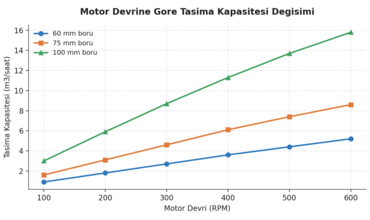
The graph below shows the effect of engine speed on conveying capacity (m³/hour) at different pipe diameters. As can be seen, the amount of material conveyed at the same speed increases significantly as the pipe diameter increases:

In practice, motor speeds in flexible helical systems are generally preferred to be in the 100-600 RPM range. At very low speeds (below 100 RPM), the conveying capacity may be insufficient, while at very high speeds (above 600 RPM), excessive friction on the material, overheating, and premature fatigue of the spring may occur.
Recommended Cycle Intervals Based on the Type of Material Being Transported
|
Material Type |
Recommended RPM Range |
Explanation |
|---|---|---|
|
Fine powder (flour, starch, additives) |
150-300 RPM |
Excessive rotation leads to dust accumulation and segregation. |
|
Medium-density granules (plastic, grains) |
200-400 RPM |
It provides balanced capacity and low wear. |
|
Heavy/abrasive granules (feed, mineral dust) |
150-250 RPM |
Low speed extends spring and tube life. |
|
Fragile/delicate product (seed, coffee bean) |
100-200 RPM |
Low speed requirement to maintain product integrity. |
The Role of Gear Ratio and Inverter Usage
The motor's nominal speed is typically around 1400-2800 RPM; however, the flexible helical spring rotating at this speed damages both the material and the spring itself. Therefore, a gearbox is installed between the motor and the helical spring to reduce the speed to a level suitable for the application. In variable-capacity production lines , a frequency converter (inverter) is preferred instead of a fixed gearbox, allowing the motor speed to be adjusted instantaneously according to operational needs. The use of an inverter provides both energy efficiency and allows for the flexible use of a single system for different products.
• Fixed gearbox systems: Suitable for lines carrying a single type of product and with low capacity variability.
• Inverter (frequency converter) systems: Ideal for flexible production lines operating with different products and capacities.
• Soft starter: Protects spring and motor life by allowing the engine to start without sudden load.
Problems Caused by Incorrect Engine Speed Selection
When the motor speed is selected based on an estimate rather than the flexible screw's capacity, various operational problems can arise. Selecting a speed that is unnecessarily high leads to increased motor amperage, premature spring fatigue, and increased energy consumption. Conversely, selecting a speed that is too low prevents the achievement of the targeted conveying capacity and creates bottlenecks in the production line.
• Excessively high speed: Motor draws excessive current, premature metal fatigue in the spring, unnecessary energy consumption.
• Insufficient turnover: Failure to reach target capacity, bottlenecks in the production line, material accumulation.
• Inappropriate rotation speed for the material: Breakage in delicate products, excessive dusting and segregation in dusty products.
Why is engine speed calculated differently for long-distance lines?
As track length increases, friction losses also increase; therefore, standard speed and motor power calculations may not be sufficient for tracks longer than 20 meters. We have examined the selection of motor speed and power for long tracks in detail in our article titled "Use of Flexible Screw Conveyors in Long Tracks" .
Frequently Asked Questions About Flexible Screw Motor Speed Selection
What should the HP or kW requirement of a flexible screw conveyor motor be?
Motor power varies depending on pipe diameter, line length, conveying angle, and the specific gravity of the material. While 0.75-1.5 kW motors may be sufficient for short and low-capacity lines, 3 kW and above motor power may be required for long and high-capacity lines.
What type of motor is used in flexible screw conveyors?
Generally, a 3-phase asynchronous electric motor and its associated gearbox are used. In applications requiring variable capacity, frequency converter (inverter) systems are preferred.
Does the carrying capacity increase as the engine speed increases?
Generally yes, but this relationship is not linear. Above a certain speed, excessive friction and heating occur on the material, which can lead to a loss of efficiency and a shortened spring life. Therefore, the optimum speed range suitable for the material type should be selected.
What are the benefits of using an inverter in flexible screw conveyor systems?
Frequency converters (inverters) allow for stepless adjustment of motor speed according to operating requirements. This enables the same system to be used flexibly for different products and capacity targets, while also softening the load during startup, thus protecting spring and motor life.
What data is used to calculate engine power?
Motor power calculations are performed by considering data such as the specific gravity of the material to be transported, the target conveying capacity (m³/hour or tons/hour), pipe diameter, line length, and conveying angle (horizontal, vertical, inclined).
What are your recommendations for selecting the correct engine speed?
When selecting the speed of a flexible screw conveyor motor, the specific gravity and viscosity of the material to be conveyed, the target conveying capacity (m³/hour or tons/hour), the pipe diameter, and the line length should all be considered together. Especially in long lines and high-capacity applications, correctly balancing motor power and speed is critical for the long-lasting and efficient operation of the system.
To select the motor and gearbox specifically for your project, you can review your load capacity targets and material specifications on our Flexible Spring Screw Conveyor product page .