Flexible Screw Conveyor Spring Selection | OMMIX
Selecting Springs for Flexible Spiral Springs: How to Determine the Right Spiral Spring?
Flexible screw conveyors, also known in the market as shaftless screw conveyors, are industrial conveying systems that transport powdered and granular materials within a closed pipe or hose using a shaftless spiral spring. Used in many production lines from agriculture to food, chemicals to plastics, the heart of flexible screw conveyors is the spiral spring rotating inside. This spring is subjected to both torsional force and friction as it pushes the material from the entry point to the exit point. Therefore, the selection of a flexible screw spring is an engineering decision that directly determines the system's efficiency, conveying capacity, and service life.
This article details all the technical parameters affecting spring selection in flexible screw conveyors, including spring wire thickness, spring diameter, pitch, material type, and the physical properties of the product to be conveyed. We will also address problems such as clogging, overheating, premature wear, and reduced conveying capacity that can arise from incorrect spring selection.
What is a flexible coil spring and what is its purpose?
A flexible auger (spiral spring) is a conveying element produced by twisting high-strength steel wire into a spiral shape with tight windings. It rotates inside a closed pipe or PVC hose under motor drive. Also called a shaftless auger, this structure, unlike traditional shaft auger conveyors, does not contain a central shaft; this allows it to be easily guided in horizontal, vertical, and angled lines. As it rotates, the spring pushes the material forward between its spiral vanes, ensuring a dust-free, enclosed transfer.
The spring's function is not only to push the material; it also transmits the torque generated by the motor along the pipe. Therefore, when selecting a spring, not only the type of material to be conveyed but also the length of the line, the conveying angle, and the motor speed should be considered together.
When the track length exceeds 20 meters, the choice of spring becomes even more critical; we discussed this issue further in our article titled " Use of Flexible Screw Springs in Long Tracks" .
Relationship Between Spring Wire Thickness and Torque Capacity
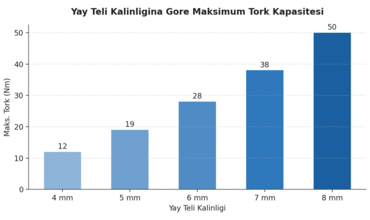
The thicker the wire of a flexible coil spring, the higher the maximum torque it can carry and, consequently, its load-carrying capacity. However, thicker wire also means less flexibility and higher cost. Therefore, a balance must be struck when choosing spring wire thickness. The graph below shows the approximate maximum torque capacity for different wire thicknesses:

Springs with a wire thickness of 4-5 mm are generally preferred for short and medium-distance conveying of light-density powders (such as flour, starch, and cement dust). Springs with a wire thickness of 6-8 mm are used for conveying heavier and more abrasive materials such as feed, granular plastics, and grains over long lines.
Compatibility between Spring Diameter and Pipe Diameter
The outer diameter of the flexible helical spring must match the inner diameter of the pipe or hose to be used with millimeter precision. If the gap between the spring and the pipe wall is too large, material backflow (efficiency loss) will occur; if the gap is too small, friction will increase, the motor load will rise, and the spring will fatigue prematurely. We have detailed all the technical criteria related to pipe selection in our article titled "Pipe Selection in Flexible Screw Conveyors ". The most common spring-pipe diameter matches used in standard flexible screw conveyor applications are as follows (Ø50, Ø60, Ø75, Ø100, Ø125 mm diameters are the most commonly produced sizes on the market).
|
Pipe Diameter |
Suggested Spring Outer Diameter |
Typical Application Area |
|---|---|---|
|
50 mm |
48-49 mm |
Additive, spice, fine powder dosing. |
|
60 mm |
57-58 mm |
Flour, starch, chemical powder transfer |
|
75 mm |
72-73 mm |
Transporting feed, grain, and plastic granules. |
|
100 mm |
95-96 mm |
High-capacity grain and granule lines |
|
125 mm |
120-121 mm |
Heavy granule and mineral dust applications. |
Selecting Spring Alloy Based on Material Type
The chemical and physical properties of the product to be conveyed are decisive in determining the spring material. Standard carbon steel springs are an economical and durable solution for materials with low to medium abrasiveness, such as grains, feed, and plastic granules. In the food, pharmaceutical, and chemical industries, where hygiene is critical, stainless steel (304 or 316 grade) springs are preferred. Stainless steel helical springs are corrosion-resistant, easy to clean, and comply with food safety standards.
• Carbon steel spring: Economical, high torsional strength, widely used in the grain and feed industry.
• Stainless steel (304) spring: Corrosion resistant for the food and general chemical industries.
• Stainless steel (316) spring: Superior corrosion resistance for pharmaceutical, advanced chemical and high humidity/acidic environments.
• Wear-resistant hardened steel spring: Long service life for abrasive granules such as sand and mineral dust.
The Effect of Pitch (Step) Spacing on Load-Bearing Performance
The spring pitch, i.e., the distance between successive spiral windings, determines the amount of material conveyed per unit revolution. Closely pitched (narrow-gap) springs are preferred for precise dosing of fine powders, while wide-pitch springs are preferred for high-capacity conveying of coarse granules. Incorrect pitch selection can lead to clogging with low-density materials and overloading of the motor with high-density materials. Pitch selection should be considered in conjunction with motor speed; we discussed this relationship in detail in our article on motor speed selection in flexible screw conveyors .
Checklist for Selecting the Right Flexible Coil Spring
• The specific gravity (kg/m³) and fluidity of the material to be transported must be determined.
• The targeted transport capacity (m³/hour or tons/hour) must be clearly defined.
• Track length, transport angle (horizontal, vertical, inclined), and direction changes should be planned.
• Spring alloy should be selected according to the abrasive and corrosive properties of the material.
• The outer diameter of the spring must match the inner diameter of the pipe/hose to be used, precisely by the millimeter.
• The engine speed and torque capacity must not exceed the maximum torque that the spring can withstand.
Frequently Asked Questions About Choosing Flexible Coil Springs
What material is a flexible helical spring made of?
Flexible helical springs are generally manufactured from high-strength spring steel (carbon steel); however, in applications where hygiene is critical, such as in the food, pharmaceutical, and chemical industries, 304 or 316 grade stainless steel is preferred.
How long does it take for a flexible helical spring to wear out?
The lifespan of a spring varies depending on the abrasiveness of the material being conveyed, the motor speed, the line length, and the spring-pipe diameter compatibility. A properly selected and regularly maintained spring can operate trouble-free for years; however, an incorrectly sized spring may show signs of premature fatigue within months.
What is the diameter in millimeters when flexible coils are manufactured?
The most common flexible screw conveyor diameters on the market are 50 mm, 60 mm, 75 mm, 100 mm, and 125 mm. The correct diameter is determined according to the specific gravity of the material to be conveyed and the targeted conveying capacity.
What is the difference between a shaftless helical and a shafted helical?
Shaftless (or shaftless) helical conveyors do not have a central shaft, which makes the structure more flexible and lighter; they can be easily guided in horizontal, vertical, and angled lines. In shafted helical conveyors, the central shaft system is fixed and is generally preferred for straight and short lines.
What factors affect the price of flexible coil springs?
Spring prices vary depending on factors such as wire thickness, spring diameter, length, steel alloy used (carbon steel or stainless steel), and manufacturing precision. Springs produced to custom specifications may be priced differently than standard sizes.
Why is expert advice important when choosing a bow?
Spring selection in flexible coil conveyors is a technical process requiring the simultaneous evaluation of multiple parameters such as wire thickness, spring diameter, pitch, material type, and track geometry. Incorrect spring selection can lead to costly problems such as low load capacity, frequent clogging, motor failures, and short spring life.
For flexible helical and rodless helical spring solutions tailored to your project, you can review the characteristics of the material to be conveyed on our Flexible Helical Spring product page .