How to Choose a PVC Mixer Blade? | Selection Criteria
Criteria to Consider When Choosing a PVC Mixer Blade
The most critical bottleneck in a PVC extrusion plant is usually the mixer section. If the mixer stops, the entire plant stops. Therefore, propellers are among the components that require the most careful handling when purchasing spare parts. The criteria to consider when selecting PVC mixer blades are not just about the dimensions of a piece of metal; it is also about the optimum combination of mechanical, electrical, and chemical parameters.
Choosing the wrong blades can burn out your mixer's motor, trigger continuous overcurrent alarms in PLC systems like the S7-1200, and result in huge electricity bills for your company. At OMMIX, we always analyze the production dynamics of our plants before selling blades to our customers. The three main parameters listed below must be considered for the correct selection.

1. Boiler Capacity and Geometric Compatibility
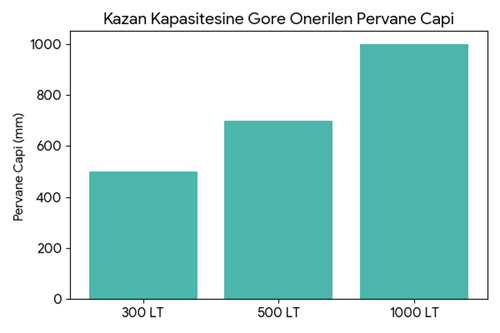
Each mixer bowl has a volume in liters (lt) (e.g., 300 lt, 500 lt, 1000 lt). The diameter of the blade must perfectly match the inner diameter of the bowl. If you try to fit a blade that is too large into a small bowl, it will not fit; more dangerously, even if it fits just barely, the thermal expansion (elongation of heated metal) is not taken into account, and at high speed, the blade may rub against the bowl, creating an explosive effect.
Similarly, if you install a small blade in a high-capacity tank, the distance between the blade and the tank wall increases significantly. Material accumulates in these "dead zones," preventing vortex formation and ensuring the mixture never becomes homogeneous. Therefore, the first rule is that the blade must be precisely compatible with your machine's make/model and tank diameter.
|
Mixer Capacity (Liters) |
Average Charge (KG) |
Recommended Propeller Diameter Range |
Expansion Tolerance |
|
200 - 300 liters |
75 - 100 KG |
450mm - 550mm |
~2 - 3 mm |
|
400 - 500 LT |
150 - 200 KG |
650mm - 750mm |
~3 - 4 mm |
|
800 - 1000 LT |
300 - 400 KG |
900mm - 1100mm |
~4 - 5 mm |
2. Formulation Structure (Calcite Content)
What product are you manufacturing? Is it a profile, a wastewater pipe, or a flexible hose? The answer to this question determines the material and coating type of the blade. If your formula uses a high percentage of calcium carbonate (calcite) (for example, 30-40 units of calcite per 100 units of PVC), you should definitely avoid standard steel blades.
For these types of abrasive formulas, tungsten carbide coated blades should be chosen. Otherwise, a standard blade you buy cheaply will melt within 2 months, creating both downtime costs and the expense of constantly buying new blades.
3. Motor Power and Current Capacity
The aggressiveness of the blade profile should be proportional to the power (kW) of your motor. If you fit a mixer with a 75 kW motor to a heavy, right-angled blade that will cut the material very quickly and require enormous torque, the motor will exceed its rated current. Your automatic compensation system may constantly exceed capacitive/inductive limits, contactors may stick, and the motor may burn out quickly if the VFD (driver) is bypassed. The blade design must support the motor operating at its nominal current.
|
Formulation (Recipe) |
Abrasiveness Level |
Ideal Propeller Material/Coating |
|
Clear PVC / Medical Grade |
Very Low |
AISI 316L (Polished) |
|
Soft PVC Cable |
Low / Medium |
AISI 304 or Hard Chrome |
|
Window Profile (Medium Calcite) |
High |
Hardox or Tungsten Edge Coating |
|
Wastewater Pipe (Excessive Calcite) |
Very High |
Full Tungsten / Armored Coating |
Be sure to check out our article, " The Impact of Worn Mixer Blades on Factory Energy Costs , " where we examine in detail the technical effects of mixer blades on your facility's power consumption and, consequently, your bills .
Frequently Asked Questions
Are heavier knives more durable?
No, weight doesn't equate to durability. On the contrary, heavy blades increase the mass load (moment of inertia) on the motor shaft and bearings. What matters is the surface hardness of the material and the coating technology.
Is it wise to buy a used or refurbished knife?
Professionally refurbished blades with perfect dynamic balance (e.g., those refurbished by OMMIX) can be used. However, substandard repairs will cause significant damage to your machine.
Does the same blade fit every mixer brand?
Not compatible. Boiler diameters, shaft mounting dimensions, keyways, and rotation directions (right/left) vary depending on the manufacturer.
How can we tell if a propeller is balanced?
Professional manufacturers (such as OMMIX) test the blades on dynamic balancing machines according to ISO 1940 standards. There should be no visible vibration in the cylinder and bearings during operation.
Do I need a special knife for flexible PVC?
Yes, soft PVC has a high oil content (plasticizer). To prevent clumping, propellers with a very well-polished surface and a more gently sloping angle should be preferred.
My mixture isn't heating up enough; could that be related to the knife?
Absolutely. If the motor is spinning smoothly and there's no speed loss, but the material isn't heating up, then your blade angles aren't suitable for your material, or the leading edges are completely blunt.
To determine the right mixer blade with the capacity best suited to your machine's motor power and formula, contact OMMIX's expert engineering team and review our turbo mixer blades page.