Effect of Calcite Ratio on PVC Mixer Blade Life
The Effect of High Calcite Content on PVC Mixer Blade Life
In industrial PVC production, calcium carbonate (calcite - CaCO3) is widely used to minimize raw material costs and to improve mechanical resistance, whiteness, and weight of the product (pipes, profiles, etc.). Especially in competitive markets like Turkey, the percentage of calcite added to formulations (based on pH) is increasing every year. However, the impact of high calcite content on PVC mixer blade life is one of the biggest headaches for maintenance supervisors and factory owners.
Although calcite stone is ground into micronized powder, when viewed at the microscopic level it resembles sharp shards of glass or pieces of rock. As the turbo mixer rotates at over 800 revolutions per minute, these thousands of tiny "glass shards" strike the leading edges of the propeller (the front surface where it cuts through the air) hundreds of times per second. This phenomenon is called "micro-abrasion" in the literature.

The Effect of Micro-Wear on Blade Metals
If your formula uses a high percentage of calcite and your blade is made of standard 304 or 316 grade stainless steel, the life of your blade is literally "numbered". Standard steel melts like butter in the face of micronized calcite crystals. The blade thickness thins within weeks, and the pointed ends of the lower blade round off.
The moment this rolling (blunting) begins, the energy problems (increased amperage), long mixing times, and material burning at the bottom of the drum, which we discussed in detail in our previous articles, start. High calcite content erodes not only the mixer blade but also the inner walls of the mixer, and similarly the screw and barrel of the extruder. Therefore, as the calcite content increases, the surface hardness (HRC/Vickers) of the machine components must also be increased.
|
Formulation Calcite (PHR) Ratio |
Example of a Usage Area |
Standard Steel Blade Life |
Proposed OMMIX Solution |
|
0 - 10 PHR |
Transparent tube / Medical |
18-24 Months |
Standard AISI 304 + Polishing |
|
15 - 30 PHR |
Standard window profile |
6-8 Months |
Hardox Body / Hard Chrome |
|
40 - 80 PHR |
Cable sheath, panel |
2-4 Months |
Tungsten Carbide Source |
|
100+ PHR |
Wastewater pipe / Skirting board |
Less than a month! |
Special Armor Coating (Tungsten) |
Calcite Grain Thickness (Microns) and Coating Requirements
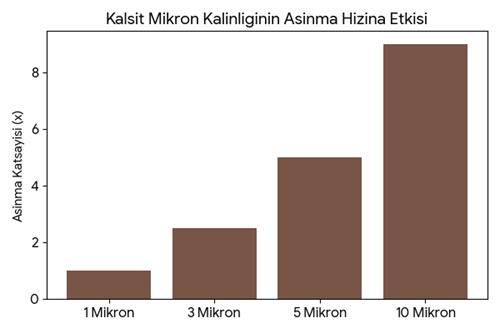
Not only the proportional excess of calcite, but also its quality (grain size - microns) affects wear. Calcite with a coarse micron size and insufficiently coated (not treated with stearic acid) scratches the metal much more aggressively. If your plant is receiving calcite with a pH of 100 or higher, not only the edges of the mixer blade but also the entire surface through which the material flows will begin to wear.
At OMMIX, we coat our blades with Tungsten Carbide (near diamond hardness) to counteract the destructive power of calcite. This coating prevents calcite particles from pushing through the metal; instead, they break themselves when scratching. The only way to reduce your machine spare parts costs without decreasing the calcite content in your formulation is to use engineered coatings that overcome the hardness of the material.
Is the Solution Only in the Knife?
Calcite erosion is not limited to the mixer blades. After reinforcing the blades, the deflector vane and cooler tank blades also need to be checked regularly. In particular, static electricity generated by the circulating material can cause calcite to adhere to the tank walls and solidify. Thanks to the OMMIX aerodynamic design, this calcification is minimized.
|
Calcite Properties |
Risk of wear |
Effect on the Mixer |
|
1 - 2 Microns (Thin) |
Middle |
It mixes homogeneously, polishing and abrading the surface. |
|
5+ Microns (Thick) |
Very High |
It scratches the metal, creating deep grooves (cavitation). |
|
Uncoated (Natural) Calcite |
High |
It has a high coefficient of friction, heating the blade very quickly. |
|
Stearic Acid Coated Calcite |
Low - Medium |
Its oily structure reduces friction and wear. |
wondering about the deadly vibrations that occur in the mixer's mechanics when the blades wear asymmetrically due to calcite, be sure to check out our latest episode , "Balance Problems and Damage to the Machine in PVC Mixer Propellers ," where we examine these issues.
Frequently Asked Questions
Will reducing the calcite content extend the life of the blade?
It will definitely get longer. However, since calcite is added to reduce raw material costs, reducing the calcite will increase your unit cost. It's more profitable to buy a durable blade instead.
Which micron thickness of calcite causes the least abrasion to the blade?
Fine-sized (e.g., 1-2 microns) calcites coated with organic substances like stearic acid cause much less abrasion to mixer blades.
My knife has wavy grooves on its surface, what is the reason for this?
This is the "cavitation" (micro-scraping) effect created on the metal surface by thick, micron-sized calcite particles colliding at high speed.
Is chrome plating sufficient to prevent calcite corrosion?
At low calcite levels, hard chrome plating is beneficial, but in very high-calcite formulations like wastewater pipes, the chrome will strip away in a month. Tungsten carbide is absolutely necessary.
Can abraded steel dust mix with the PVC formula?
Yes. Especially if you are producing white window profiles, the metal dust from the melting blade can mix with your material, causing a grayish (dirty) color or black streaks.
Does OMMIX offer a warranty for high-calcite producers?
When you share your formula (PHR value) with us during the design and coating phase, we produce the longest-lasting armored knife set specifically for your facility.
Meet OMMIX Tungsten armored propellers, specially developed for high-fill production runs .