Flexible Screw Conveyors in Long Lines Over 20 Meters | OMMIX
Flexible Screw Conveyors for Long Lines: What to Consider in Applications Over 20 Meters?
Flexible screw conveyors can be used in a wide range of applications, from short-distance dosing applications to production lines tens of meters long. However, when the line length exceeds 20 meters, the mechanical loads on the system, friction losses, and motor power requirements increase disproportionately. Therefore, the use of flexible screw conveyors in long lines requires a different engineering approach compared to standard short lines.
This article details the technical challenges encountered in flexible screw conveyor lines over 20 meters in length, the relationship between motor power and efficiency loss, the points to consider in spring and tube selection, and solutions that improve performance in long lines. For standard spring and tube selection criteria applicable to short lines, you can find them in our articles titled "Spring Selection in Flexible Screw Conveyors " and "Tube Selection in Flexible Screw Conveyors" .
What changes as the line length increases?
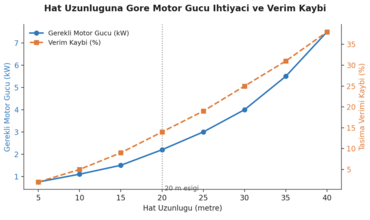
In a flexible screw conveyor system, the spring, while rotating, both pushes the material forward and counteracts the frictional forces caused by its own weight and the pipe wall. As the line length increases, the sum of these frictional forces also increases; this necessitates the motor producing more torque, thus requiring a more powerful motor and a thicker spring. Furthermore, conveying efficiency (amount of material conveyed per unit of power) is lower on long lines compared to short lines.

As shown in the graph, when the 20-meter threshold is exceeded, both the required motor power and the loss rate in conveying efficiency begin to increase significantly. Therefore, standard short-line calculations should not be used in flexible screw conveyor projects exceeding 20 meters; the system should be designed from the outset with a long-line logic.
Motor and Gearbox Selection for Lines Over 20 Meters
When selecting motor power for long lines, not only the amount of material to be conveyed but also the total length of the line, the number of direction changes (elbows, angles), and the vertical conveying ratio should be taken into account. Each additional meter and each additional direction change increases the total frictional resistance on the system. Therefore, for lines over 20 meters, a motor in a higher power class and a higher gear ratio are generally preferred compared to standard lines. Furthermore, due to the high load at startup, the use of a soft starter or frequency converter is recommended to protect the motor and spring life. We have explained the general logic of motor speed and power selection in detail in our article on motor speed selection in flexible screw conveyors .
How does the selection of springs and tubes differ in long-distance lines?
In flexible helical spring lines exceeding 20 meters, the spring wire thickness should be selected to have a higher torque capacity compared to shorter lines, because the torsional load that the spring must carry accumulates and increases along the line. Similarly, the pipe wall thickness should be chosen to be more durable in long lines, and if possible, the line should be supported with intermediate bearings at certain intervals instead of a single piece. Intermediate bearings reduce the sagging and vibration of the spring over long distances, ensuring more stable operation of the system.
• String thickness: For long strings, a string one level thicker than for standard strings should be preferred.
• Pipe wall thickness: Thicker wall thickness should be used for long lines to ensure mechanical strength.
• Use of intermediate bearings: In long and multi-segment lines, supporting the spring reduces vibration and wear.
• Number of direction changes: Since each additional bend increases the total frictional resistance, the route should be kept as simple as possible.
Ways to Prevent Capacity Loss on Long-Distance Routes
To avoid unexpected reductions in transport capacity on lines longer than 20 meters, the system must be correctly sized during the project phase. The following measures help reduce efficiency loss on long lines:
|
Precaution |
Benefits it provides |
|---|---|
|
Choosing an engine in a higher power class. |
It provides stable capacity by compensating for friction loss. |
|
Using a thick wire spring |
It extends spring life by resisting increased torsional loads. |
|
Intermediate bearing / support points |
It reduces sagging and vibration of the spring. |
|
Speed control via frequency converter. |
It softens the takeoff load and provides energy efficiency. |
|
Simplifying the route (fewer bends) |
Reduces overall frictional resistance. |
In which sectors are long, flexible screw conveyor lines used?
Flexible screw conveyor lines exceeding 20 meters are frequently preferred in large-capacity silo bottom feeding systems, cement and construction chemical plants, large-scale feed factories, long-distance feed conveyor lines in poultry farms, and for transferring materials from the outlet of large storage facilities to the production line. In such long lines, designing the system correctly from the outset significantly reduces operating costs in the long run.
Frequently Asked Questions About the Use of Flexible Screw Conveyors in Long Lines
Up to what length can flexible spirals be manufactured?
Flexible screw conveyors can be produced in long lengths as a single piece thanks to their shaftless structure. Lines of 20 meters and above are possible, but at these lengths, the motor power, spring wire thickness, and pipe support must be calculated differently compared to standard short lines.
Why does transport capacity decrease on lines longer than 20 meters?
As the line lengthens, the frictional resistance between the spring and the tube accumulates and increases. This leads to a decrease in the amount of material transported per unit time (transport capacity) in a system operating with the same motor power. Therefore, longer lines require a more powerful motor and a more suitable spring/tube combination.
Is it necessary to use intermediate bearings in long, flexible spiral conveyor lines?
Yes, especially in multi-segment and long lines, intermediate bearings reduce spring sag and vibration, ensuring more stable and longer-lasting system operation.
What are the ways to reduce energy consumption on long-distance transmission lines?
The use of frequency converters (inverters), simplification of the route (reducing unnecessary bends and directional changes), and the selection of correctly sized motors and gearboxes are the main methods of increasing energy efficiency in long lines.
In which sectors are flexible screw conveyors over 20 meters used?
Silo bottom feeding systems are commonly used in cement and construction chemical plants, feed mills, feed drive lines in poultry farms, and large warehouse-production line connections.
What should the correct engineering approach be for long-distance pipelines?
Applying standard short-line solutions to flexible screw conveyor lines longer than 20 meters leads to problems such as low capacity, frequent failures, and short spring life. In long lines, motor power, spring wire thickness, pipe wall thickness, and route design must be considered as a whole, and supported by intermediate bearings if necessary.
please visit our Flexible Spring Screw product page for information on line length, materials to be conveyed, and target capacity .