Production Automation with PLC in Dosing Machines
How can PLC automation in dosing machines improve production line efficiency?
In the modern Industry 4.0 and dark factory era, where capacity and speed are pushed to their limits, the true beating heart of industrial facilities doesn't beat in mechanical gears, but in the advanced automation systems (the brain) that tell those machines what to do. The days when massive dosing machines consisted only of steel frames, contactors, and crude mechanical parts, and the operator pressed buttons by hand and eye, are long gone.
Today, these massive systems are flawlessly managed by AI-integrated PLC (Programmable Logic Controller) based industrial computers that collect and analyze analog and digital data from hundreds of sensors (speed, temperature, pressure, and weight) in the field within microseconds, making instantaneous response decisions far faster than human intelligence. We will examine the technical infrastructure of these PLC components, whose contributions to production efficiency, zero-downtime, and flawless quality are undeniable, and the deep IT/OT network design behind a dosing electrical panel.
Industry Standard: Siemens S7-1200 / S7-1500 and Advanced Analog Data Processing

Especially in industrial projects in Turkey and Europe, compact PLC systems like the Siemens S7-1200 series, or massive ones like the S7-1500 series, have proven their robustness, extensive communication support, and easy troubleshooting, becoming the industry standard and acting as the brains of dosing units and factories. The greatest strength of these PLCs is their ability to read the extremely weak and interference-prone analog weight signals from load cell sensors operating in heavy silo conditions, thousands of times per second, without error, using specially designed hardware weight reading modules (e.g., Siemens SIWAREX module) or 24-bit 4-20mA converters.
Backend Database Integration: SCADA with PHP and MySQL
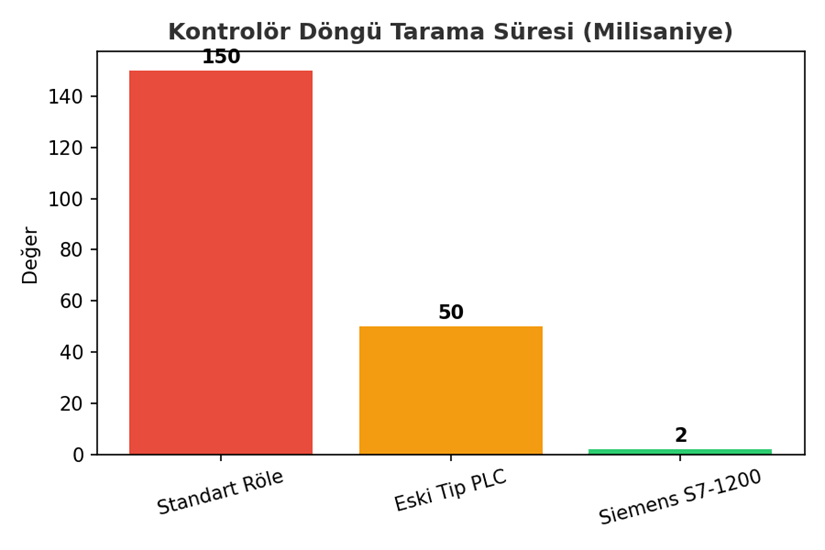
The live production and weight consumption data collected from the field by Siemens PLC doesn't just remain on the screen in the world of automation. In factories with a modern IT vision, this data is instantly transmitted from an OPC-UA server to the factory's local backend servers. Thanks to PHP-based interfaces and flexible MySQL database architectures running on these servers, production engineers can monitor how many kilograms of cement are being drawn from the silos at any given moment, the formula fidelity rates, with live graphs from their mobile phones or a web panel (SCADA) in their offices, and can convert all data into Excel/PDF reports with a single click. This weight data is processed with millisecond PLC scan cycles, guaranteeing that the system maintains production quality with its gravimetric lossless feeding principle.
|
System Hardware Component |
The Fundamental Mathematical Task in Automation |
Operational Advantage in Terms of Fieldwork and Productivity |
|
Main CPU (Ex: Siemens S7-1200 PLC) |
The logic controller of the entire system performs millions of operations per second. |
Very fast response time, flexible and advanced programming languages (Ladder Logic, SCL, FBD) for easy updateability. |
|
HMI Panel (Touch Screen) |
A graphical command interface where the operator enters prescription grammages and views alarms. |
Ease of use even in harsh factory conditions (with gloves), live monitoring of real-time PID and weight chart trends. |
|
Motor Driver Device (VFD/Inverter) |
The PLC adjusts the screw motor's speed precisely while maintaining its torque, based on commands from the PLC. |
With PID loop commands, it perfectly slows the engine down in the final grams approaching the target without stalling, completely eliminating waste. |
Motor Control Panel (MCC), Critical Network Isolation and Automation Circuit Design

What transfers the latent power of the mechanical system to the screw conveyors and chassis in the field is a well-designed, grounded, and thermally insulated industrial MCC motor power board. Driving heavy 3-phase asynchronous giant motors with high torque and controlling the bridge-breaking agitator blades that solve dust clogging requires not only hardware but also very strict electrical safety.
IT & OT Network Security (Firewall and Isolation)
In a network-based automation circuit, the biggest risk is cyber or network traffic latency. For example, if CAD programs from the company's design office (e.g., Solidworks PDM, heavy design render transfers) are running simultaneously on the factory's industrial local area network (LAN) controlling the machine, downloading/uploading massive gigabytes of data uncontrollably in the background, this creates network traffic congestion. Profinet packets (stop commands per second) from the PLC to the drive are delayed by milliseconds, and the screw conveyor cannot stop in time (due to the delay), causing incorrect weight to be dispensed into the system and quality rejection. To prevent these cyber crises, IT rules (Windows Firewall settings), VLAN configurations, and industrial network devices must be used to strictly isolate the IT network from the PLC/OT automation network physically and software-wise (with an isolated router).
Lossless Production with Intelligent PID (Proportional-Integral-Derivative) Algorithm
The most critical technology that enables PLC hardware to move beyond simply starting and stopping and behave like an 'artificial master' is the PID (Proportional-Integral-Derivative) closed-loop function blocks within it. The system constantly calculates the mathematical error difference between the target weight entered by the engineer and the actual live weight (feedback) flowing to the scale, and to close this error, it makes instantaneous and very smooth interventions in the current speed (frequency between 0-50 Hz) it sends to the motor driver using proportional (P), integral, and derivative (D) calculations. It never suddenly stops the auger, causing a shock.
An advanced PLC automation system, commissioned by a skilled engineer with very precise PID coefficient (parameter) settings, perfects the weighing accuracy of the machine to the level of a jeweler's scale. Although the initial investment (hardware/software) cost may seem quite high to managers, the prevention of waste, the elimination of faulty recipes (defective products), and the ability of a single employee to manage massive production lines from a central location provide the factory with very long-term operational profitability (low OPEX) and unparalleled prestige.
|
Communication Protocol |
Physical / Architectural Feature |
Its Place and Role in the Automation System |
|
Profinet / EtherCAT |
It is based on industrial Ethernet, is incredibly fast, time-sensitive (deterministic), and extremely reliable against interrupts. |
The main control unit (PLC) and VFD drives are the backbone connection between the factory's central SCADA room or the public cloud ERP network. |
|
Modbus RTU / TCP-IP |
The economical, unlicensed infrastructure is highly universal and can instantly and easily integrate with almost any brand on the market. |
Economical communication with local VFDs (Vehicle-Driven Fluid Dependents) within the control panel, ambient sensors, and inexpensive weight reader indicators. |
|
Traditional Analog 4-20mA Voltage |
Traditional hardware, physical cabling, and a signal structure far more resistant to electromagnetic power noise (EMI) than 0-10V. |
Transmitting pure data/signal from a remote loadcell reader transmitter (amplifier) to the analog input (AI) card on the main PLC. |
Frequently Asked Questions
Which global PLC hardware brands are generally preferred for a high-end dosing machine investment, and why?
Worldwide, Siemens (S7-1200 / S7-1500 series), Allen-Bradley (Rockwell), Omron, and Schneider Electric are consistently the preferred gold standards for automation projects due to their industrial stability, robust software ecosystem, robustness in harsh environments, and the easy availability of spare parts/modules even after 20 years.
In PLC system software, where are hundreds of different product recipes (mixture formulas) safely stored even if the power goes out?
The PLC hardware securely stores production recipes in its internal retentive/non-volatile memory areas within dedicated Data Block (DB) structures, supported by batteries/capacitors. If desired, for data security, thousands (or even unlimited) production recipes can be exported and backed up to the SSD memory of the HMI display directly connected to the device, to an external USB flash drive, or to the main SCADA server.
Can this closed-loop PLC system in the machine connect directly to the company network (the Internet) via the cloud, and is this secure?
Yes, but with specialized hardware. Through powerful Industrial VPN Router devices or hardware firewalls that provide security, the machine can only access the internet in a controlled and encrypted manner via the desired ports. Thanks to this architecture (IIoT), the engineering company that manufactured the machine can remotely connect to the device from anywhere – Germany or Istanbul – to perform troubleshooting, error diagnosis, or remote software updates for new features.
If the main power supply at the factory collapses/is interrupted while the machine is performing a high-intensity dosing operation according to the exact formula, will the information about the amount of missing material dosed be completely lost?
Absolutely not, it won't get lost in quality hardware. In a proper automation control panel architecture, the moment the power (current) is interrupted or fluctuates, the main CPU instantly writes and freezes all active weight counters, positions, and targets to its permanent EEPROM flash chip (retain memory). When the power returns and the generator kicks in, the PLC recovers and the system confidently continues the production process from where it left off, at the same half-kilogram and helical rotation, without a single error.
To cut costs, is it possible to perform gravimetric or precision dosing using only an old-style contactor (operating on-off) without using a PLC and frequency motor drive (inverter)?
Absolutely impossible. A true gravimetric or lossy weighing system requires extremely precise speed and velocity control (deceleration with PID algorithm). Because standard contactors only switch electricity on and off (1 or 0, i.e., full power or full stop), even if the screw rotates at full speed and stops instantly, the residual momentum and free-fall inertia in the air cause the material to exceed the target weight by a significant amount (kilograms), resulting in fatal (continuous) production losses that are irreversible in the formula.
How can sensitive electronic PLC and drive automation panels located within the field be physically protected 100% from heavy, sandy, humid, and aggressive chemical dusts?
Electrical power panels and HMI mounting enclosures should be manufactured with a mechanical protection rating of at least IP54, but ideally and reliably IP65 (a strict requirement for cement and flour environments). Their covers should be made of high-quality cast, sealed polyurethane gaskets, feature a high-quality locking mechanism, and be made of thick sheet metal or, in corrosive areas, stainless steel, in a single, monolithic form, preventing dust and moisture ingress. If cooling is required, the panel's internal fans must be of the thin foam cassette type, filtering dust from the outside.
you can check our guide "What Factors Affect Prices in Dosing?" to see the elements that affect investment costs .
For customized powder dosing systems for your factory and all the necessary technical information, please review our Dosing Systems product.