PVC Mixer Blade Types and Impeller Functions | OMMIX
What are the types and functions of PVC mixer blades?
The production and processing of PVC (Polyvinyl Chloride) depends on the homogeneous mixing of the material. In the plastics industry, high-speed turbo mixers are used to ensure that resins, stabilizers, fillers such as calcite, and pigments achieve the desired molecular structure. The heart of these mixers is undoubtedly the mixer blades (propellers). The types and functions of mixer blades have a wide range of effects, from the quality of the PVC produced to the amount of energy consumed by the factory.
As we've seen in the machines and spare parts we produce at OMMIX, not only does the mixing time increase when the wrong mixer blade is selected, but the load on the machine's mechanical components and motors also increases significantly. An ideal PVC mixer blade should ensure that the material moves in the tank with the correct aerodynamic flow (vortex).

Hot (Turbo) Mixer Blades and Their Specifications
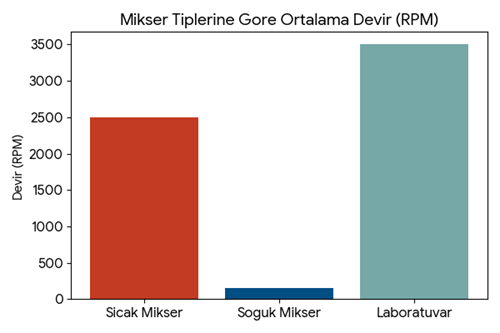
Hot mixers operate on the principle of friction heat. Blades, driven by a motor at high speed (typically 700-1100 RPM), rub the polymer particles against each other and the walls of the mixing chamber, converting kinetic energy into heat energy. This allows the material to reach temperatures of approximately 120°C - 130°C, enabling additives to penetrate the PVC resin.
Hot mixer propellers typically consist of three different layers or profiles. The lower blade scrapes the material from the bottom and pushes it upwards. The middle blade reinforces the vortex structure of the material inside the drum, while the upper blade (guide blade) prevents the material from hitting the drum lid and clumping, redirecting it back to the center. The design angles of these blades are simulated using millimeter-precise calculations in CAD programs like SolidWorks before production.
|
Blade Layer |
Its main function |
Rotation Speed Effect |
|
Lower Blade |
Bottom material scraping and removal |
High torque (requires torque at takeoff) |
|
Medium Blade |
Homogenization and friction creation |
Very High (Heat Generation) |
|
Upper (Deflector) Blade |
Material downward pressure and vortex control. |
Medium (Air release) |
Cold Mixer Impellers and Cooling Dynamics
The PVC mixture, brought to its gelling point in a hot mixer, cannot be fed directly into the extrusion line. Doing so would cause clumping and degradation due to the sudden temperature difference. Therefore, the material is transferred to a cold mixer (cooler) to reduce its temperature to 40°C - 45°C.
Cold mixer impellers rotate at much lower speeds (typically 60-120 RPM) compared to hot mixers. Their primary function is not to create friction, but to accelerate heat transfer by continuously contacting the material with the cooling jacketed tank walls. The blade structure is generally designed with a large surface area and suitable for slow mixing. Thanks to their geared design, they generate high torque, therefore the material-pushing surfaces of the blades must be highly resistant to mechanical stress.

The Role of Blade Angles and Materials
The angle a mixer blade makes with the horizontal axis directly affects the amperage the motor draws from the mains. Aggressively angled blades heat the material faster, but they overload asynchronous motors, increasing electricity consumption and inverter (drive) heating. Furthermore, the material of the blade is as critical as its function. In formulations containing high levels of calcite (CaCO3), wear-resistant blades (Hardox or specially coated) should be used instead of standard stainless steel.
|
Mixer Type |
Propeller Material |
Average Revolutions Per Minute (RPM) |
|
Hot (Turbo) Mixer |
AISI 304 / Coated Steel |
700 - 1100 |
|
Cooler Mixer |
AISI 304 Stainless Steel |
60 - 120 |
|
Laboratory Mixer |
AISI 316 Stainless Steel |
800 - 1200 |
you can check out our next article, " Causes and Symptoms of Wear in PVC Mixer Propellers ."
Frequently Asked Questions
What is the difference between a hot mixer blade and a cold mixer blade?
The hot mixer blade is designed to rotate at high speed, generating heat through friction and causing the material to gel. The cold mixer blade, on the other hand, rotates at a lower speed, aiming to cool the material by impacting it against the large surface area of the mixing bowl.
Why are mixer blades manufactured in three layers?
To create a perfect vortex of material inside the mixing bowl: the lower blade lifts, the middle blade stirs, and the upper blade pushes the material towards the center, preventing it from rising into the air.
What happens if the angle of the lower blade is incorrect?
The material at the bottom of the boiler cannot be pushed upwards sufficiently, clumping (combustion) occurs at the bottom, and the mixing time is prolonged. Furthermore, the load on the motor becomes unbalanced.
Will the mixing speed up if the deflector (guide) blade is removed?
No, on the contrary, the material splashes towards the tank lid, creating an irregular flow and unnecessarily straining the motor, drawing excessive current.
How often should cold mixer blades be replaced?
Because cold mixers operate at lower speeds, their blade life is much longer than that of hot mixers. They are generally replaced every 2-3 years based on physical inspection and wear indicators.
What material are OMMIX mixer blades made from?
They are manufactured as standard from AISI 304 or high-strength steel, and wear resistance is increased by applying special tungsten or titanium coatings depending on the formulation and calcite content.
To learn more about our mixer blades, which offer the most suitable aerodynamic design for your formulation and drum structure, with OMMIX assurance, please visit our Turbo Mixer Blades page.