Circular Screen Capacity Calculation and Deck Selection | OMMIX
Capacity Calculation and Number of Factors Selection Criteria in Circular Screens
Circular vibrating screens play a critical role in the classification of powder, granular, or liquid materials in industrial facilities. Accurate capacity calculations and the determination of the appropriate mesh size are essential to prevent these machines from creating bottlenecks in the production line. Circular screen capacity calculations depend not only on the machine diameter but also directly on the physical properties of the material and the open area ratio of the screen mesh.
How to Calculate Circular Sieve Capacity?
The basic formula for capacity calculation is based on multiplying the sieve surface area by the material's passage velocity through the sieve (flux density). However, in practice, bulk density, particle size distribution, moisture content, and material shape directly affect this formula. For example, dry silica sand with high free-flowing properties and moist, sticky clay powder have completely different hourly capacities through the same sieve diameter.

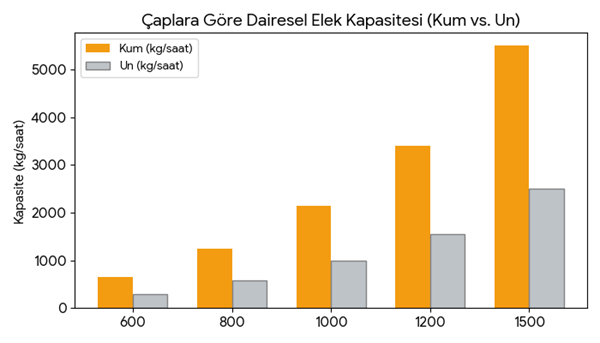
The table below shows the average sieve diameter and hourly capacity estimates for standard free-flowing materials:
|
Sieve Diameter (mm) |
Screen Area (m²) |
Estimated Capacity - Sand (kg/hour) |
Estimated Capacity - Flour (kg/hour) |
|
600 |
0.26 |
500 - 800 |
200 - 400 |
|
800 |
0.46 |
1000 - 1500 |
450 - 700 |
|
1000 |
0.72 |
1800 - 2500 |
800 - 1200 |
|
1200 |
1.05 |
2800 - 4000 |
1300 - 1800 |
|
1500 |
1.65 |
4500 - 6500 |
2000 - 3000 |
The time the material spends on the sieve surface during the screening process also affects capacity. Motor angles are crucial for optimizing the movement and spread of the material on the sieve. For technical details on this topic, you can review our article on Circular Sieve Vibration Motor Weight Angle Adjustment .
Increased moisture content in the product causes particles to adhere to the wires, creating "blinding." This rapidly reduces the open area ratio and can halve the hourly capacity.
Number of Decks (Deck) Selection Criteria
In circular sieves, the number of decks is determined by how many different fractions you want to separate the product into. A single-deck sieve separates the material only into "under" and "over" fractions (scalping/control sieve); a three-deck sieve allows you to obtain four different product sizes (grading/classification).
As the number of layers increases, the overall height of the machine and the mass weight of the material descending to the lower layers change. Therefore, chassis strength is vital in multi-layer screens. For detailed information on chassis design and material selection, you can refer to our article "Circular Screen Chassis Design and Sealing Measures" .
|
Transaction Type |
Suggested Number of Floors |
Intended Use |
|
Safety/Control Intervention |
1-story |
Separating foreign substances and lumps from the product. |
|
Precise Classification |
2 or 3 stories |
Obtaining final products with different micron sizes. |
|
Dust removal |
1 or 2-story |
Removing fine dust particles from the main product. |
|
Liquid-Solid Separation |
1-story |
Filtering solid particles from syrup, wastewater, or oil. |
As the number of layers increases, the risk of clogging in the lower meshes (fine mesh) also increases. To understand the integration of systems that will prevent fine particles from clogging the wires, see Circular Mesh Clogging Prevention Methods. You can take a look at our article.
Frequently Asked Questions
1. How can the capacity of a circular screen be increased?
To increase sieve capacity, you can use high open area ratio mesh wire, optimize the vibration motor's weight angles to suit the material, and integrate anti-clogging ultrasonic systems.
2. How do moist products affect sieve capacity?
When the moisture content exceeds 5%, particles tend to stick together and to the mesh. This can reduce hourly capacity by 30% to 60%.
3. How many layers of circular sieve should I buy?
If you only need to separate large foreign particles, you should choose a single-layer sieve; if you want to separate your product into 3 different sizes, you should choose a double-layer sieve.
4. Is the sieve diameter directly proportional to the capacity?
Yes, as the sieve diameter increases, the surface area increases squarely. For example, going from 600 mm to 1200 mm increases the surface area by approximately four times.
5. What is the open space ratio?
It is the percentage ratio of the voids on the mesh to the total surface area. As the mesh thickness decreases, the open area increases and the capacity increases.
If you are experiencing capacity bottlenecks in your production line and want to find the most suitable sieve size for your process, get acquainted with OMMIX's highly efficient circular sieve systems, designed with our engineering expertise. For expert support in capacity calculations and to examine our products in detail, please visit our Circular Sieve product page .