Preventing Screen Wire Clogging: Ultrasonic and Bouncing Ball Systems
Preventing Mesh Clogging: Ultrasonic and Bouncing Ball Systems
One of the biggest problems encountered in industrial screening processes is mesh clogging. This condition, referred to in the literature as "blinding" or "pegging," means that particles become trapped in the mesh pores, reducing the open area ratio to zero. You can find information on how a clogged mesh disrupts capacity calculations and reduces production speed in our article "Circular Sieve Capacity Calculation and Layer Selection ."
To prevent blockages and ensure continuous production, two main cleaning systems are used: mechanical and acoustic. These are Bouncing Ball and Ultrasonic Vibration Systems.
Bouncing Ball Mechanism
The most common type of mechanical cleaning system, the bouncing ball mechanism, consists of a thicker, perforated sheet metal plate (slider plate) placed beneath the main screen wire and elastic balls that move freely between these two surfaces. These balls, continuously launched upwards by the main vibration of the screen, strike the screen wire from below (transfer of kinetic energy), dislodging trapped particles.
The material of the balls used must be selected to be compatible with the chassis sealing gaskets. For food-grade chassis designs and material selection, you can read our article Circular Sieve Chassis Design and Sealing Measures .

Ultrasonic Screen Cleaning Systems
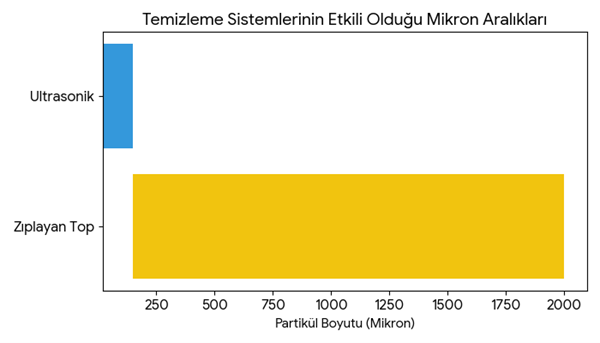
Especially with mesh sizes of 100 microns and below (very fine mesh), cleaning with kinetic energy alone is insufficient. Electrostatic attraction, moisture, or fine particle geometry cause the meshes to adhere tightly. This is where ultrasonic systems come into play.
High-frequency signals from the ultrasonic generator are converted into high-frequency but very low-amplitude mechanical vibrations via a transducer connected to the sieve pulley. This micro-resonance on the wire surface reduces friction between the material and the wire to zero (fluidization effect), causing the material to virtually float on the wire. For details on optimizing motor angles for material guidance, please refer to our article on Circular Sieve Vibration Motor Weight Angle Adjustment .

|
Feature |
Bouncing Ball (Mechanical) |
Ultrasonic System (Acoustic) |
|
**Target Micron Range** |
100 microns and above |
20 Microns - 150 Microns |
|
**Working Principle** |
Kinetic pulse energy |
High-frequency micro-vibration |
|
**Material Type** |
Dry grains, granules, seeds |
Metal powders, dust, electrostatic paint |
|
**Wear Effect** |
Because it hits the string from below, it can shorten the string's lifespan. |
Telescopically, it avoids mechanical shocks, extending its lifespan. |
|
**Cost** |
Low |
High |
Solution Selection Table Based on Mesh/Micron Value
|
Mesh Value |
Micron Equivalent |
Recommended Cleaning System |
|
10 - 40 Mesh |
2000 - 400 Microns |
Bouncing Ball (Polyurethane/Rubber) |
|
40 - 100 Mesh |
400 - 150 Microns |
Bouncing Ball (Silicone) |
|
100 - 200 Mesh |
150 - 75 Microns |
Ultrasonic System |
|
200 - 500 Mesh |
75 - 25 Microns |
Ultrasonic System (Mandatory) |
Frequently Asked Questions
1. What is the difference between blinding and pegging?
Blinding is the process of fine-grained materials coating the pores of a wire due to moisture or static electricity. Pegging, on the other hand, is the physical insertion of particles between the wires, like nails.
2. How often should the bouncing balls be replaced?
The balls should be replaced when their diameter shrinks by 20% due to wear or when they lose their elasticity (usually every 6-12 months).
3. Can the ultrasonic system be retrofitted to any sieve?
No, in order to distribute the ultrasonic waves homogeneously, the screen frame must have a special resonant ring.
4. Are bouncy balls used in the food industry?
Yes, but only FDA (Food and Drug Administration) approved white silicone bouncing balls should be used. Black rubber balls can lead to contamination.
5. How much does an ultrasonic generator increase capacity?
Especially for fine powders under 50 microns, ultrasonic systems provide a significant production advantage by increasing capacity by 100% to 400%.
OMMIX circular screens eliminate clogging problems with their FDA-approved bouncing ball mechanisms and high-frequency ultrasonic systems, specifically designed for your process. For uninterrupted screening performance and detailed system integration, please visit our Circular Screen product page .