Technical Features Determining Dosing System Prices
The Most Important Technical Specifications Determining Dosing System Prices and Investment Costs
When establishing a new industrial production line or planning a capacity increase (overhaul), plant managers or purchasing departments preparing a machine purchase budget (CAPEX) are often faced with a surprisingly wide and variable price range. To logically understand why there can be disproportionate price differences (price gaps) of up to 3-4 times between two machine or system offers that are physically almost identical and appear to perform the same function in the brochure, it is necessary to thoroughly analyze the hidden engineering behind the sheet metal casings, the metallurgical quality, and, most importantly, the class of the electronic components (automation), and to carefully question the vendor's technical arguments.
Purchasing a dosing machine for a facility simply because it's cheap will, in the coming months, significantly offset the actual cost through production waste, constantly malfunctioning sensors, and downtime caused by mechanical failures. To learn about the fundamental technological differences that directly affect the price and how these devices work, you can read our detailed article at [https://ommix.com.tr/blog/dozajlama-sistemlerinde-gravimetrik-ve-volumetrik-farklar]. Now, let's take a closer and transparent look at the most concrete engineering factors that fundamentally determine the investment cost and vendor list prices of an industrial weighing machine.
Mechanical Body, Chassis Weight and Metal Alloy Material Quality

The type and thickness of the sheet metal used in the outer casing, lower support frame, and internal rotating conveyor screws (blades) of the dosing machine is the largest mechanical component that most ruthlessly and directly alters the price in the offer. A machine manufactured from standard, painted ST37 grade carbon steel (black sheet metal) with a thin wall thickness is very cost-effective, but it offers no resistance (durability) to corrosion, moisture, acid, or severe wear.
Cost Spike in Food and Pharmaceutical Segments
In industries such as food, veterinary medicine, pharmaceuticals, or abrasive chemicals, where regulations (FDA/GMP) require food-grade, fully compliant AISI 304 stainless steel or the much more expensive, corrosion/acid-resistant AISI 316L stainless steel, the raw material cost alone (due to the market price of stainless steel) naturally increases by 2-3 times. Adding TIG/Argon welding and internal mirror polishing (polishing workmanship) further differentiates the price.
|
Machine Mechanical Housing / Screw Material |
Approximate Cost Impact on Overall Equipment Budget |
Approved Industrial Use and Production Area |
|
Thin-sheet ST37 Carbon Steel + Standard Industrial Paint |
Very Low Cost (Economic Entry Segment) |
Coarse agricultural applications, mining, cement, coal dust, non-food non-abrasive dry powders. |
|
Thick Wall AISI 304 Stainless Steel + Industrial Welding |
Medium to High Cost Level (Industry Standard) |
Plastic polymer granules, paint masterbatches, general dry food products (wheat flour, salt, cube sugar) |
|
AISI 316L Stainless Steel + Laser Welding + Flawless Interior/Exterior Mirror Polishing (Hygienic CIP Design) |
Highest Cost (Premium / Pharma Grade) |
Acidic and lactic liquid foods (tomato paste, dairy products), pharmaceutical capsules, and highly chlorinated and salty, strong, aggressive chemicals. |
System Intelligence and Automation Level: Volumetric or Gravimetric?

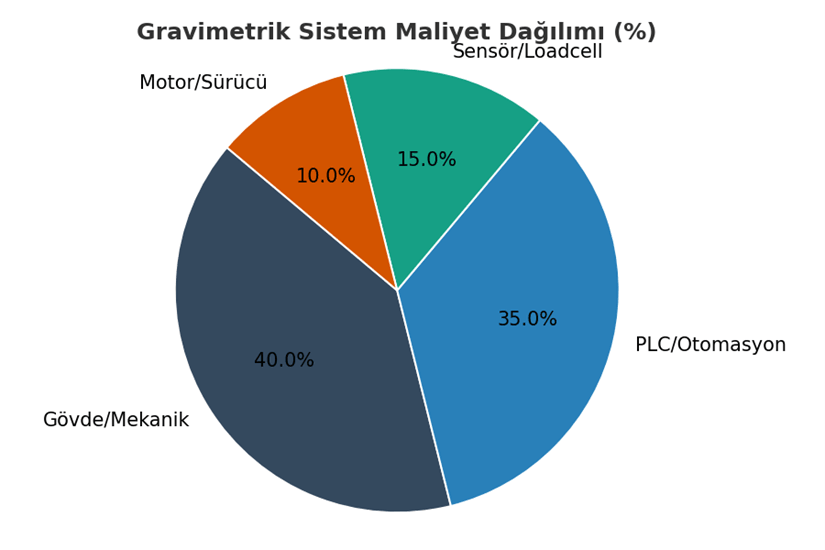
After the physical mass of iron (the machine chassis), the biggest technological and intellectual component determining the price on the bill is undoubtedly the automation ( intelligence ) infrastructure of the system. The simplest, most rudimentary volumetric dosing system you'll buy usually only includes a geared asynchronous motor and a simple (sometimes even contactor-based without an inverter) drive switch (on/off logic) in the electrical panel. This is cheap, but offers zero warranty from production.
Cost of Technology: Loadcell, PLC, SCADA
However, when a technological breakthrough is made and a fully automated gravimetric (weight-measuring or loss-in-weight) intelligent production system is adopted, high-resolution, stainless steel (IP68) load cells placed under the system, expensive and licensed PLC devices (such as Siemens S7-1500) to process the data, multi-color operator HMI touch screens, and special German-made weight reading sensor modules (SIWAREX etc. AD converters) that read those millivolts thousands of times per second come into play. Since all of these technological sensors are imported and Euro-based, they naturally make the system more expensive.
|
Component Group Found in the Machine |
Economic Choice (Affordable Price / Stock / Low Durability) |
Premium Industrial Choice (High Cost of Living / 24/7 Long Lifespan / Stability) |
|
Brain / Automation (PLC and Display) |
Cheap, unsupported, standard relay/weak PLC-equipped small boards of Asian/Far Eastern origin. |
Siemens S7/S1500 series or Allen Bradley / Wide and Robust Capacitive Touch HMI SCADA interface |
|
Sensor and Weighing Unit (Loadcell) |
Standard aluminum die-cast alloy, OIML C1, IP65 only (Partial water/full dust resistance), affected by outdoor conditions. |
Fully laser-welded stainless steel block, IP68 or IP69K rated, heat-compensated, high-resolution OIML C3/C6 certified. |
|
Mechanical Power, Motor & Gearbox |
Unnamed or locally manufactured subcontracted standard, overheating, heavy and inefficient drivetrain units. |
High energy efficient (IE3/IE4), maintenance-free, imported (Nord, SEW, etc.) long-lasting gear sets with special bearings and synthetic oil lubricant. |
Frequently Asked Questions
What is the average return on investment (ROI) for an expensive, state-of-the-art dosing machine at the facility?
If your factory already has a high rate of raw material (dye, additives, etc.) waste or completely discarded (rejected) defective production lots (and operator theft/spillage errors), a high-quality gravimetric system that automates this process will, through the precision it creates without any manual intervention and the cost savings it provides on expensive raw materials, fully recoup the huge price difference and start generating profit within 6 months to 1.5 years, depending on capacity.
For those on a low budget, is it a good idea to buy a cheap second-hand (used/refurbished) dosing machine or screw conveyor from the market, and what are the risks?
Especially since load cell weighing pans and PLC control panels are completely enclosed electronic components, they can be severely worn and fatigued from overvoltage, vibration, or misuse; you cannot see inside. Furthermore, there is almost a 100% chance that old steel screw conveyors (especially those with sand-covered screw heads) are worn down to the millimeter, like a razor blade. A brand-new system, offering a warranty, software compatibility, and immediate on-site manufacturer technical service guarantee, is a much cheaper and safer investment for factories planning 24/7 uninterrupted production.
Does the price quoted by the company usually include on-site installation, pipe welding, and PLC commissioning?
While this certainly varies depending on the vendor, companies offering corporate and professional industrial solutions, such as OMMIX, generally don't just leave the machine at your doorstep; they offer mechanical assembly, cable tray installation, electrical automation commissioning, idle dry testing, and then, most importantly, wet testing with raw materials (commissioning and calibration) as a free operational standard within the price quotation package ( turnkey ).
Would having a custom-built, high-capacity machine (e.g., flat bunker) designed to fit the narrow ceiling dimensions of my factory site be significantly more expensive than standard box-type machines?
Yes. Standard stock machines in manufacturers' catalogs (brochures) are mass-produced (assembly line method), eliminating engineering (R&D) costs and optimizing material consumption, making them extremely economical. However, tailor-made designs with custom laser engineering calculations, including static strength testing (FEA), mechanical engineer 3D drawing effort, chassis bending mold preparation, and custom cutting production (project planning) man-hour costs, will inevitably increase the price of the device proportionally.
In terms of long-term periodic operating and maintenance costs (OPEX items) at the factory, which type of system is generally much cheaper?
From a maintenance perspective alone, volumetric systems have significantly lower spare parts and operating costs compared to gravimetric (intelligent) machines because they lack the delicate sensor (load cell) prone to failure, complex display panels, intricate calibration, or sensitive data cables (just iron, a motor, and a simple contactor).
When negotiating with a vendor to lower the price (offer) of a dosing machine for a budget-constrained investment, which engineering modules should 'never' be compromised on?
Savings (discounts) can be requested in terms of the aesthetics of the outer casing, the thickness of the body sheet metal, or using standard paint instead of polyurethane paint, or simpler motor drive brands can be selected from subcontractors. However, 'never' should any compromise be made on the quality of the load cell (weighing sensor) resolution (e.g., using a sealed IP68/69K class instead of a cheaper OIML C1 class IP65) and the hardware (processor) stability of the PLC software just to reduce the price. Otherwise, the system will become obsolete due to insufficient technology, and the raw material waste (scrap/waste) that leaks in each shift will inevitably be added to the factory's bill as a hidden engineering reality.
Before investing in a powder dosing system, you can review the basic operating principles and mechanical differences of the system by referring back to our main guide, " Differences Between Volumetric and Gravimetric Weighing in Dosing" .
For customized powder dosing systems for your factory and all the necessary technical information, please review our Dosing Systems product.