How to Increase Weighing Precision in Dosing?
How to increase weighing accuracy to prevent production waste in dosing processes?
In modern industrial facilities where competition is fierce, raw material procurement costs constitute by far the largest component of total production expenses (typically between 60% and 80%). Even a 1% weighing deviation or error in dosing systems in the food, pharmaceutical, automotive, or plastics industries can lead to hundreds of thousands of dollars in raw material waste or substandard product manufacturing, considering the annual production volume.
Therefore, maximizing the weighing accuracy of a dosing system integrated into production lines is a vital engineering task, not just by purchasing the device, but also by isolating it from environmental and electrical factors in the factory environment. So, what steps should be taken in terms of automation, mechanics, and installations to bring weighing accuracy closer to laboratory levels and reduce production waste to zero?
Mechanical Isolation and Ambient Vibration Control

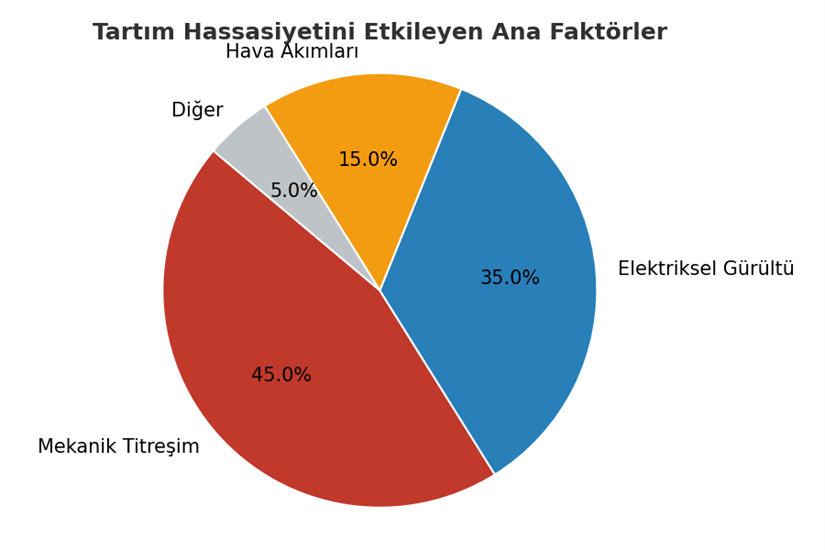
Mechanical vibration is the number one natural enemy of industrial weighing systems and load cell components. Impacts from a nearby large crusher directly reflecting off the system chassis, forklift traffic in a side aisle, or even vibrations generated by the agitator motor of the dosing unit itself, all translate into 'ghost loads' on the load cells.
Anti-Vibration Chassis Designs
These constantly fluctuating, disruptive data points interfere with the PLC's PID calculations. To completely prevent this, the dosing unit should absolutely not be rigidly attached directly to the main building's steel platform; it should be mounted on independent, heavy, and thick-walled chassis with rubber or spring-loaded shock absorbers to dampen vibration frequencies. Furthermore, the pipes exiting the auger must be connected to the system with flexible fabric bellows, not rigid welding.
|
Source of Error / Cause of Interference |
Effect and Symptoms of Weight Loss |
Definitive Solution and Improvement Method |
|
Mechanical Vibration (Engine or Factory Floor) |
Continuous millisecond fluctuation in the load cell signal (mV/V) |
Anti-vibration damping pads, flexible fabric bellows, and independent heavy-duty chassis are used. |
|
Electrical Noise (Electromagnetic Interference) |
Sudden large deviations and freezes in analog indicator signal readings. |
Tight panel grounding, insulated grounding rod and shielded sensor cable usage. |
|
Air Flows and Positive/Negative Pressure |
False heavy/light load formation on the bunker due to vacuum or wind. |
Pressure equalization valves (breather valves) and shutting off fans that are blowing into the system from the outside. |
Eliminating Electrical Interference and Providing Clean Panel Grounding

In high-tech automation systems, especially those supported by PLCs, the analog reference signals from load cell sensors are extremely weak (typically at the 2-3 millivolt level). Electromagnetic interference (EMI/harmonics) emitted by high-power motor drives (VFD/Inverter) or large contactors operating in industrial motor control panels directly interferes with this sensitive analog signal, causing unwarranted fluctuations in the displayed weight.
Separation of Signal Line and Power Line
In motor control unit (MCC) design, failure to provide a perfect star ground connection will fundamentally impair weighing accuracy. It is absolutely essential that sensor cables (signals) are not routed alongside high-current 3-phase power cables in the same cable tray; a distance must be maintained between them, or they must be routed through different lines. Furthermore, positioning load cell converter modules as close to the PLC as possible, preferably via digital communication (Profinet/Modbus), will prevent data losses.
Correct Helical Geometry and Motor Driver Configuration
Weighing accuracy is not only about being able to weigh electronically, but also about being able to physically translate the reading into the system, i.e., controlling the transmission system. When the drive (inverter) frequency is significantly reduced in the last 100 grams, the auger must be able to rotate stably without losing torque (without stalling) even at very low motor speeds.
If the screw pitch or pipe diameter of the screw conveyor is chosen to be larger than necessary for the capacity to be conveyed, even when the screw rotates a quarter turn, a much larger mass will fall from the system in the form of a lump, and the accuracy will be completely lost. Selecting the correct screw pitch according to the fluidity of the material is a critical hardware requirement, as much as software optimization.
|
Hardware that Determines Sensitivity |
Operational Contribution to Precision |
Criteria to Consider During Field Installation |
|
Loadcell Converter (Weight Amplifier) |
It reads very weak analog signals and converts them to interference-free digital signals for PLCs. |
A high-resolution (at least 24-bit ADC) module with a high sampling rate should be selected. |
|
Motor Driver (VFD/Inverter) |
In accordance with the PID cycle, it perfectly slows down the engine speed in the final grams. |
When operating at low frequencies (Hz), attention must be paid to motor cooling and torque loss. |
|
Droplet/Free-fall Compensation |
Even if the auger stops, it can calculate the final weight of the object falling through the air at that moment. |
In PLC software, PID flight parameters must be carefully adjusted according to the physical flow characteristics of the material. |
Frequently Asked Questions
Do airborne dust particles or ventilation pipes in a factory environment affect the weighing?
Yes, it definitely has an effect. The negative/positive pressure created by dust collector filters connected to the dosing bunker or by general factory suction fans creates a vacuum or pressure effect on the load cell surfaces, distorting the weighing by grams. The system must be balanced in an open environment.
What should the dosage accuracy (tolerance) be under ideal industrial conditions?
According to industry and material-independent standards, a well-designed and calibrated gravimetric system should have an error margin (accuracy) within a very narrow tolerance range, varying between ±0.5% and ±0.1% of the target weight.
If the loadcell cable is cut and extended in case of a malfunction, will the sensitivity decrease?
Cutting standard analog load cell cables and splicing them with regular terminals or extending the cable will immediately impair voltage readings and accuracy because it changes the internal resistance (Ohms). If an extension is necessary, a specially insulated 'Junction Box' should be used.
What is the free fall (or in-flight) error or its compensation in automation?
The moment the system closes the auger and the motor stops, there is material floating in the air that has exited the chute but has not yet fallen into the weighing pan. When this material falls into the pan, the target weight is exceeded. Advanced PLC software anticipates this falling material and compensates for it by stopping the motor much earlier.
Do seasonal temperature variations within the facility affect weighing accuracy?
Yes, extreme temperature differences (e.g., day-night or summer-winter) can cause thermal expansion, leading to stress on the mechanical steel frame of the dosing device. Therefore, high-quality load cell sensors have built-in temperature compensation circuits.
Who should perform the periodic calibration of weighing indicators and load cells, and how should it be done?
The span adjustment must be performed periodically (e.g., every 6 months) by the facility's maintenance team or certified technicians from the manufacturer, using traceable M1 or F1 class reference steel weights that comply with state standards, and electronically adjusted.
To understand the critical industry-specific impacts of precise weighing processes and examine raw material control, you can refer to our article, "The Role of Dosing Devices in Plastics Production ."
For customized powder dosing systems for your factory and all the necessary technical information, please review our Dosing Systems product.