Balance Problems in PVC Mixer Impellers and Damages to the Machine
Balancing Problems in PVC Mixer Propellers and Their Damage to the Machine
In industrial machinery, every mass rotating at high speed must have perfect weight distribution (balance). Just as a car vibrates at 100 km/h if its wheels are not balanced, a heavy steel mixer blade rotating at enormous speeds of 700 to 1200 RPM will, so to speak, dismantle your machine if it operates without balance. Balance problems in PVC mixer impellers and the damage they cause to the machine are a critical engineering problem that should not be taken lightly, as they can result in the collapse of the mechanical system.
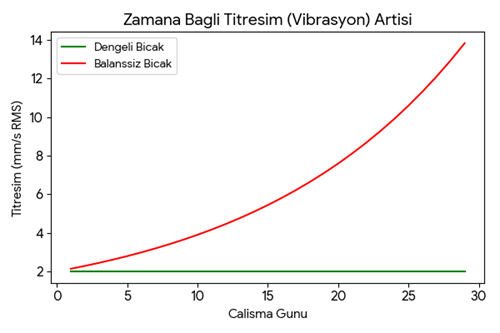
Imbalance usually results not from poor machining of a newly produced blade, but from asymmetrical (uneven) wear of the blade during operation due to calcite or the adhesion of hardened PVC material. When one blade is only a few grams lighter than the other, the resulting centrifugal force is amplified by the rotational speed and returns to the rotor shaft as a tremendous vibration.

Destructive Effects on Bearings and Shafts
The vibration energy resulting from imbalance first travels to the rotor shaft. The shaft is constantly forced to bend (whip) to one side. This damages the seal bearings on the shaft. When the seals are damaged, fine calcite and PVC powder from inside the housing seeps through the shaft and directly enters the bearings.
Bearings are the supports of a mechanical system. A bearing that is exposed to dust and also subjected to excessively asymmetrical loads due to imbalance will heat up and fail very quickly. The failure of mixer bearings initiates a chain reaction that can lead to the main shaft seizing (locking), the drum base tearing, and even the gearbox or motor shaft breaking. The main culprit in this entire catastrophic scenario is an unbalanced mixer impeller.
|
Source of the Balance Problem |
Component it affects |
Type of Failure Resulting |
|
Asymmetric wear (melting of a wing) |
Main Shaft / Shaft |
Shaft bending, runout |
|
Material sticking (bonding) to the blade |
Felts (Sealing) |
Dust leak, oil leak |
|
Welded Repair (Uncontrolled filling) |
Bearings |
Overheating, bearing seizure/failure. |
|
Bolt/Looseness (Loose assembly) |
Motor / Coupling |
Coupling failure, motor connection breakage. |
Vibration Analysis and Dynamic Balancing Standards
In advanced facilities, mechanical maintenance teams perform Vibration FFT Analysis by placing sensors in motor and shaft bearings. When a vibration value that normally ranges from 2-3 mm/s reaches levels of 10 mm/s, this means "stop the machine immediately and check the balance."
OMMIX balances all its blades on high-precision machines to ISO 1940-1 G2.5 or G6.3 industrial balancing quality standards. Invisible millimeter weight differences are detected by computerized systems, removing material from unseen points on the blades and ensuring perfect rotational stability.

Returning to electrical automation systems; on the mechanical side, a balance problem affecting the bearings will cause the motor to require more torque to rotate, which will again result in higher amperage and electricity bills.
|
Vibration Level (RMS mm/s) |
Machine Status |
What needs to be done |
|
0.1 - 2.5 mm/s |
Very good |
Normal production flow. |
|
2.5 - 7.0 mm/s |
At the border (Warning) |
During scheduled maintenance, the blades should be cleaned and inspected. |
|
7.0 - 11.0 mm/s |
Critical Level |
Production should be stopped and the blades replaced at the first opportunity. |
|
11.0+ mm/s |
Danger (Emergency Stop) |
The machine must be shut down immediately; bearing and shaft damage is imminent. |
Frequently Asked Questions
Why does the balance of a knife get disrupted on its own?
Due to the calcite content, one wing may wear down a millimeter more than the other. Or, PVC that melts during hot mixing may stick like a stone to one corner of the wing, adding extra weight.
How can balance problems be identified other than through vibration?
The machine's operating sound (humming and banging sounds) changes. When you touch the drum body (with safety precautions), you will feel an unusual vibration.
If we weld a broken knife ourselves, will it upset the balance?
It will be 100% damaged. Every gram of welding wire added to the blade is transferred to the bearings as kilograms of impact due to centrifugal force. The machine must be rebalanced after repair.
Are OMMIX mixer blades delivered balanced?
Yes. Every blade leaving our factory (after the coating process is complete) is connected to a dynamic balancing machine, balanced with zero errors, and shipped ready for assembly.
How often should maintenance be performed to prevent bearing failure?
For high-speed, hot mixers in particular, it is recommended to perform periodic vibration checks (or listening) every month, and detailed seal/bearing checks every 6-8 months.
Can an unbalanced blade damage the gearbox?
Yes, in cold mixers, the propellers are connected not directly to the motor, but to a reduction gearbox. Imbalance wears out and breaks the gearbox gears very quickly.
To protect your mixers—the heart of your plant—from imbalance vibrations and bearing failures, choose OMMIX blades, perfectly balanced on CNC machines.