Coating Technologies in Turbo PVC Mixer Blades
Anti-wear coating technologies for Turbo PVC mixer blades.
The use of high calcite (CaCO3) content in industrial PVC production to reduce formulation costs has a destructive effect on machine parts. When the impellers of turbo mixers, rotating at speeds of tens of meters per second, encounter this abrasive dust, standard stainless steel parts lose their lifespan within months. Anti-wear coating technologies for turbo PVC mixer blades represent the greatest innovation that surface engineering has offered to the plastics industry to solve this problem.
At OMMIX, we know that simply manufacturing blades from thick metals isn't a solution; it will only increase the current drawn by the motor and the mechanical mass (inertia). The real solution is to achieve surface hardness close to diamond levels while maintaining the blade's aerodynamic structure (thinness and sharpness). This is only possible with advanced coatings.

Applications of Tungsten Carbide
Tungsten carbide (WC) is one of the hardest alloys known in the industry. It is the most commonly applied coating method for mixer blades. Specifically, it is applied to the "leading edges" where the blade first encounters the material and to the ends of the lower scraper blade using special welding methods (PTA or laser cladding).
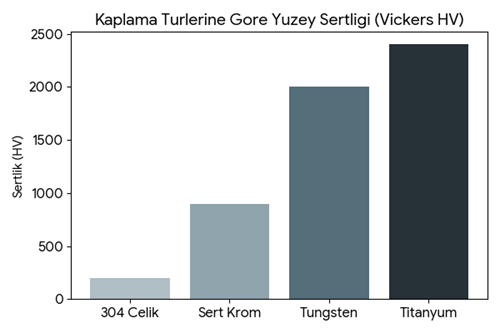
A tungsten-coated blade offers 8 to 10 times greater resistance to wear than a standard AISI 304 steel blade. This coating preserves the blade's edge profile. Because the profile remains unchanged, the motor's electrical consumption stays constant, the mixing time doesn't increase, and the contactors in the compensation panel are spared from unnecessary switching. The factory's long-term maintenance and operating costs are dramatically reduced.
|
Coating Material |
Vickers Hardness Rating (HV) |
Wear Resistance Factor (Compared to Standard Steel) |
|
Standard 304 Steel |
~200 HV |
1x (Reference) |
|
Hard Chrome Plating |
~850 - 1000 HV |
2x - 3x |
|
Tungsten Carbide (WC) |
~1500 - 2500 HV |
5x - 7x |
|
Titanium Nitride (TiN) |
~2000 - 2400 HV |
4x - 6x (Fine micron applications) |
Hardox Material and HVOF Thermal Spray Technology
Another method involves manufacturing the blade body from wear-resistant armor steels such as Hardox 450 or 500 and then thermally spraying it using the HVOF (High Velocity Oxygen Fuel) technique. In this method, ceramic or carbide powders are impacted onto the blade surface at speeds faster than the speed of sound, creating a mechanical locking mechanism.
The biggest advantage of these coatings is the smoothness of the surface. The smoother the blade surface, the less friction the PVC powder slides with. This reduces thermal fatigue. OMMIX determines the coating technology that offers the most optimum cost/performance ratio by looking at your company's production recipe and daily tonnage, and designs the propellers accordingly.

Effects of Coating Process on Balance and Mechanics
The coating process cannot be done haphazardly. After tungsten carbide welding, the center of gravity of the blade changes. If connected to a 3000 rpm motor in this state, it will create enormous vibration. Therefore, after all coating processes, the blades must be dynamically balanced on high-precision machines. When combined with proper balancing, coating technology also protects the bearing life of your machine.
|
Mixture Formula |
Recommended Propeller Type |
Expected Life Expansion |
|
Pure PVC / Low Calcite |
Standard AISI 304 / 316 |
+0% (Standard) |
|
Medium Level Calcite |
Hard Chrome Plated |
+150% - 200% |
|
High Calcite (Pipe/Cable) |
Tungsten Carbide Source |
+400% - 600% |
|
Overly Aggressive Fillers |
Hardox Body + HVOF Tungsten |
Over 600% |
In addition to the material used in the blades, if you'd like to examine the effect of the propeller's geometric shape on the process, you can read our article "The Effect of Propeller Design on PVC Mixing Time and Quality" .
Frequently Asked Questions
Can tungsten coating be applied to every mixer blade?
It is applicable to most industrial turbo mixer blades. However, the base body material of the blade must be suitable for welding and holding the coating.
How much more expensive are coated knives than standard knives?
The initial investment cost may be 60-80% higher. However, due to its five times longer lifespan and energy savings, the ROI (Return on Investment) period is very short.
Will the coating peel or lift?
Yes, when done with poor quality methods. In PTA or HVOF methods applied according to OMMIX standards, the molecular/mechanical bond is very strong, and coating peeling does not occur.
Is the entire blade coated with tungsten?
Generally, no. To optimize vibration and cost, only the leading (cutting) edges and bottom points, where wear is most intense, are coated.
Can a coated knife be recoated when it gets old?
If the blade body has not lost its main dimensions and only the coating area is worn, the old coating can be ground down and re-coated.
Which industries should definitely use coated knives?
Facilities that produce PVC wastewater pipes, cable sheathing, and high-fill PVC profiles should definitely use coated blades.
If you're tired of constantly changing blades and production downtime at your facility, consider OMMIX's long-lasting tungsten-coated mixer blades .