Vibration Motor Angle Adjustment and Flow Geometry | OMMIX
Vibration Motor Weight Angle Settings and Their Effect on Material Flow Geometry
At the heart of circular vibrating screens are flanged vibrating motors (vibromotors), the most critical component determining the material's movement characteristics across the screen. The angle (phase angle) at which the eccentric weights (balances) located at the top and bottom of the motor are adjusted directly shapes the flow geometry of the material on the screen surface. Correct adjustment is vital for screening efficiency and capacity.
Functions of Upper and Lower Weights
The upper eccentric weight controls the centrifugal force in the horizontal plane, causing the material to move radially from the center to the periphery. The lower eccentric weight, on the other hand, directs the vibration and tangential force in the vertical plane, causing the material to follow a helical path.
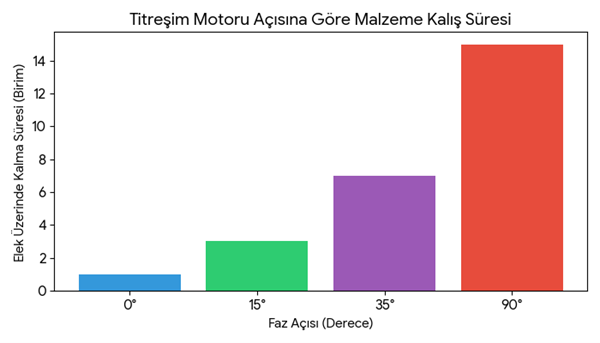
Adjusting the angle between these two weights determines how long the material will remain on the sieve surface. You can read more about the role of material spreading time on the sieve in capacity calculations in our article Circular Sieve Capacity Calculation and Layer Selection .

Material Flow Characteristics According to Phase Angles
Motor weight angles are typically adjusted between 0° and 90°. Depending on the selected angle, the flow geometry changes as follows:
|
Angle Degree |
Material Movement (Flow Geometry) |
Most Suitable Area of Use |
|
0 Degrees |
It moves very quickly in a straight line from the center to the periphery. |
Separation of large particles, rapid fluid drainage (Scalping). |
|
15 Degrees |
It traces a short, rapid spiral from the center outwards. |
Standard capacity general screening, fast product output. |
|
35 Degrees |
It traces an ideal spiral that scans the entire sieve surface. |
Precise classification, dust sieving, and highly efficient processes. |
|
90 Degrees |
It gathers in the center and moves outwards very slowly. |
Situations where very fine and light materials need to remain on the sieve for an extended period. |
While angles between 35° and 90° are preferred, especially for fine micron materials, clogging can occur in the mesh during this slow flow. Solutions to address such situations can be integrated into the Circular Mesh Clogging Prevention Methods. You can find more information in our article.

The Effect of Flow Geometry on the Chassis
The three-dimensional vibration dynamics (vortex motion) created as the motor angle changes also alters the direction of the loads on the sieve chassis and sealing gaskets. Selecting a chassis material resistant to intense resonance and lateral forces is crucial. Technical details regarding chassis materials and corrosion resistance can be found in our article "Circular Sieve Chassis Design and Sealing Measures" .
|
Type of Screening |
Material Type |
Suggested Angle |
|
Control Screening |
Flour, Sugar, Grains |
15° - 35° |
|
Liquid Filtration |
Sherbet, Wastewater, Oil |
0° - 15° |
|
Precise Classification |
Metal Powder, Chemicals |
35° - 45° |
|
Ultra Fine Screening |
Electrostatic Powder Coating |
45° - 90° |
Frequently Asked Questions
1. What happens if the vibration motor angle is adjusted incorrectly?
If the angle is very close to zero, the material is quickly expelled without being screened. If the angle is very close to 90 degrees, the material accumulates in the center, and the capacity decreases significantly.
2. How can I change the angle of the top and bottom weights?
You can open the engine cover, loosen the bolt securing the lower camshaft weight, rotate it according to the angle scale on it, and then tighten it again.
3. What angle should I use for liquid filtration?
In liquid screening, rapid removal of solid particles is desired. Narrow angles between 0-15 degrees provide the highest discharge velocity.
4. Does the motor angle affect the lifespan of the mesh wire?
Yes, the accumulation of material in the middle of the sieve at very wide angles (90 degrees) can cause the sieve wire to tear prematurely in the middle section.
5. If material is accumulating in the middle of the sieve, what should I do with the angle?
If the material is clustered in the center, the phase angle is too high. You can reduce the angle to 35° or 15° to allow it to spread out.
OMMIX brand circular sieves are equipped with special flanged vibration motors with an easily adjustable, precise angle scale. Maximize your efficiency by adjusting the flow geometry specific to your process in seconds. See our Circular Sieve product page for more information. You can visit.